About Contact

B.Arch Studio 2.2 · UAP · 2013

At the Hearth
of the Real

Hillside Residence · Chittagong Sacred Threshold · Memory Vastu · Feng Shui · Bengali Vernacular

Mircea Eliade wrote that the home is the place where the chaos of profane space is consecrated into world. The doorsill is not a line on a plan; it is the edge of the ordinary. To dwell is to install a centre. To enter is to cross. The fire at the middle of the dwelling, the hearth, is the axis around which the rest of the cosmos arranges itself.

The studio gave a brief: design a home for an architect. The answer began before any line was drawn, with an X-Ray Study: eight pages of citations and diagrams asking what a home is, ontologically, before asking what one looks like. Eliade on sacred space. Zumthor on the brass door handle of his aunt's house, shaped like the back of a spoon, that taught him architecture before he had a word for it. The Vastu Purusha Mandala mapping the cosmos onto a square of ground. The principles of Feng Shui. Mowla's diagrams of the Bengali bari, its courtyard cradled at the centre, its verandahs negotiating with the monsoon. Each was a way of saying the same thing differently: home is not a programme; it is an orientation.

The project's name is a small substitution. Eliade's phrase is "at the heart of the real". This residence keeps the cadence and changes one letter. The shift from heart to hearth pulls the question out of metaphor and back into matter, where the architect must answer it. Where the heart abstracts, the hearth burns. Where the heart symbolises, the hearth warms. The home becomes the place where the real is not contemplated but kindled.

The site is an 18,800 square foot plot in the Rangamati District of Chittagong Division, on the hillside above the Kaptai Lake. The ground here does not lie flat; it folds toward water. Section drives plan. Five levels step down the slope, the architect descending through their own dwelling before reaching the lake at the bottom and the sky at the top. The building is south-facing: every window opens toward the Kaptai Lake. The arrival is from above; the procession is gravitational. The house obeys the ground rather than negating it.

Programme Private Residence
Architect's Family
Site Hillside, 18,800 sqft
Rangamati, Chittagong Division
Institution University of Asia Pacific
Dhaka, Bangladesh
Studio B.Arch Studio 2.2
Project 2
Composition 5 Levels · Two Masses
Residence + Service Quarter
Themes Sacred Threshold · Memory
Vastu · Feng Shui · Bengali Bari

Threshold

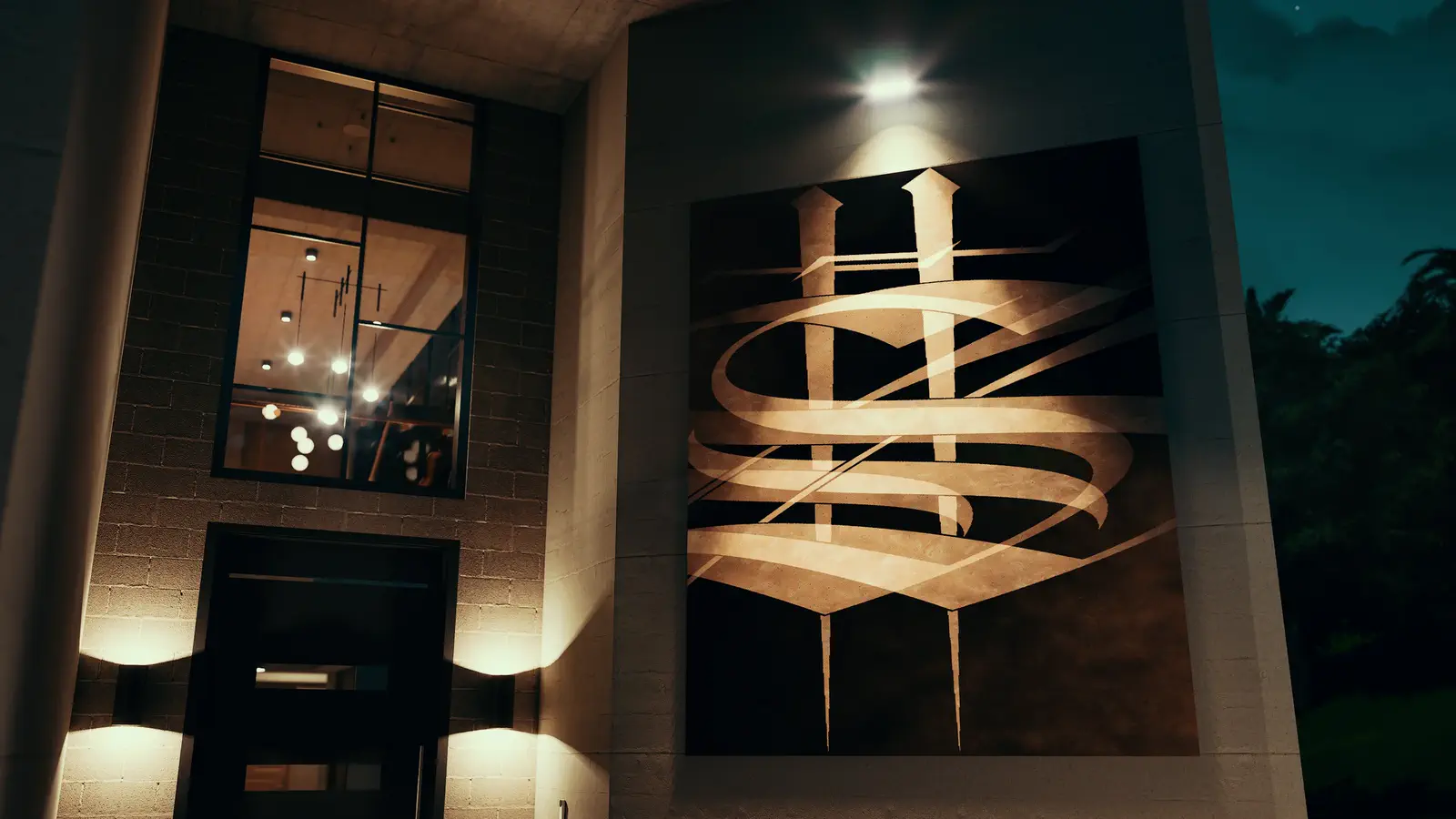
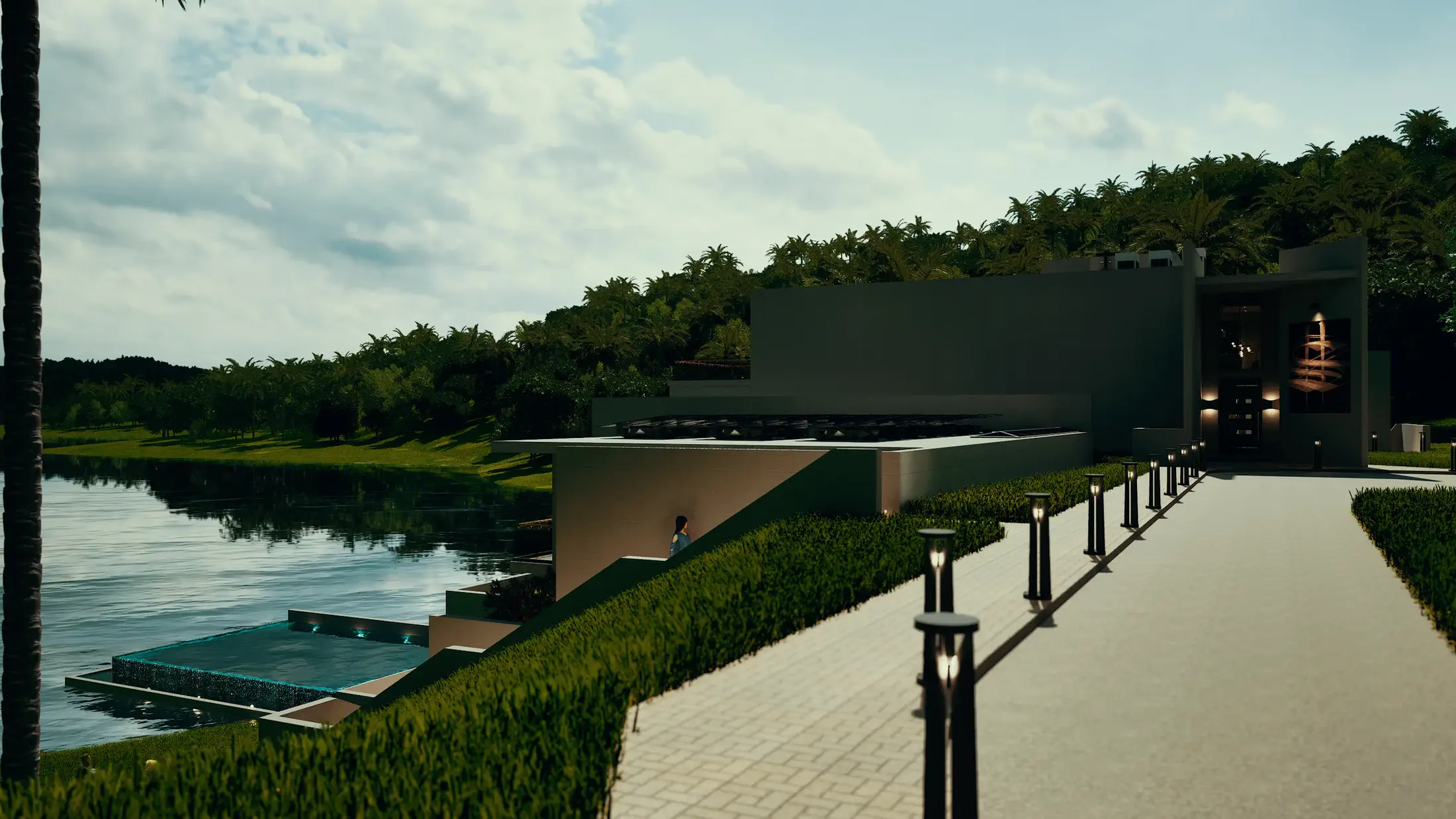
Zumthor remembers a brass door handle before he remembers architecture. The first architectural fact of any house is the moment of crossing: from the world outside to the world the house has decided to be. Here that moment is articulated as a single framed gesture: a double-height vestibule, an exposed brick face, a calligraphic panel washed by a single downlight. The signature is Bengali, the gesture Eliadean. Beyond the foyer the formal living unfolds, orientated south toward the Kaptai Lake.
View from the property entry toward the main entry of the building: arrival path leading to the double-height vestibule, brick wall and calligraphic panel ahead Property Entry
Entry threshold at night: brick wall with calligraphic panel washed by downlight, double-height glazed vestibule beside a chandeliered lobby Main Entry · Night
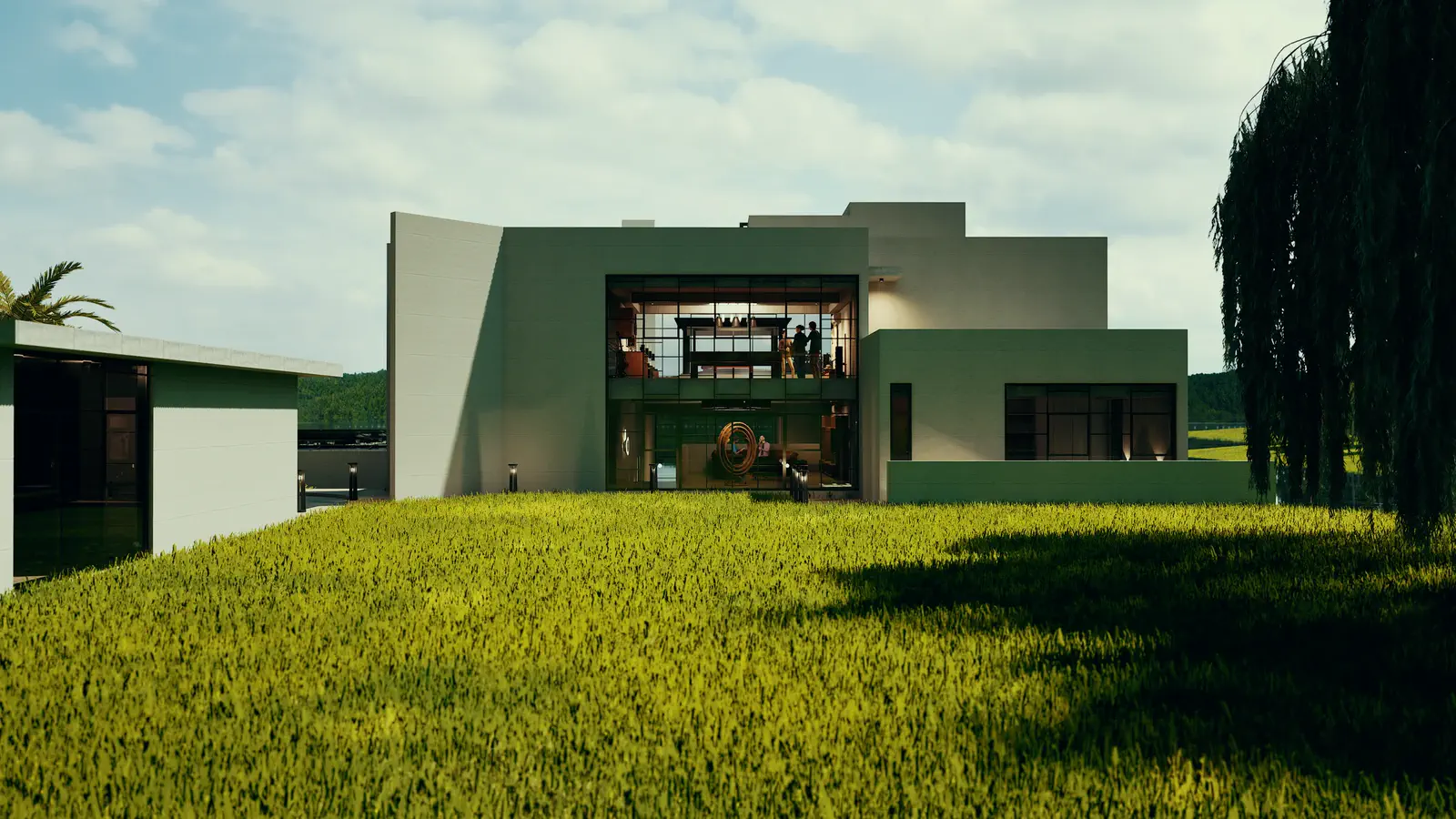
Day approach to the north facade: street arrival side of the residence, the entry volume and upper levels visible from the road approach North Façade · Day
Formal living viewed from the foyer at Level 4: entry volume opening into the living space, south-facing glazing and Kaptai Lake beyond Formal Living from Foyer · Level 4

Section Drives Plan

The road meets the upper terrace. The house begins where the ground breaks. From the street, only the topmost level is visible: a garage, a foyer, a formal living, a guest bed. The rest of the dwelling is carved into the slope below. To find the family living room you descend. To find the kitchen, the architect's studio, and the pool you descend further. Only the rooftop climbs back toward sky. The architectural narrative is gravitational: arrival, descent, water; ascent for the view.
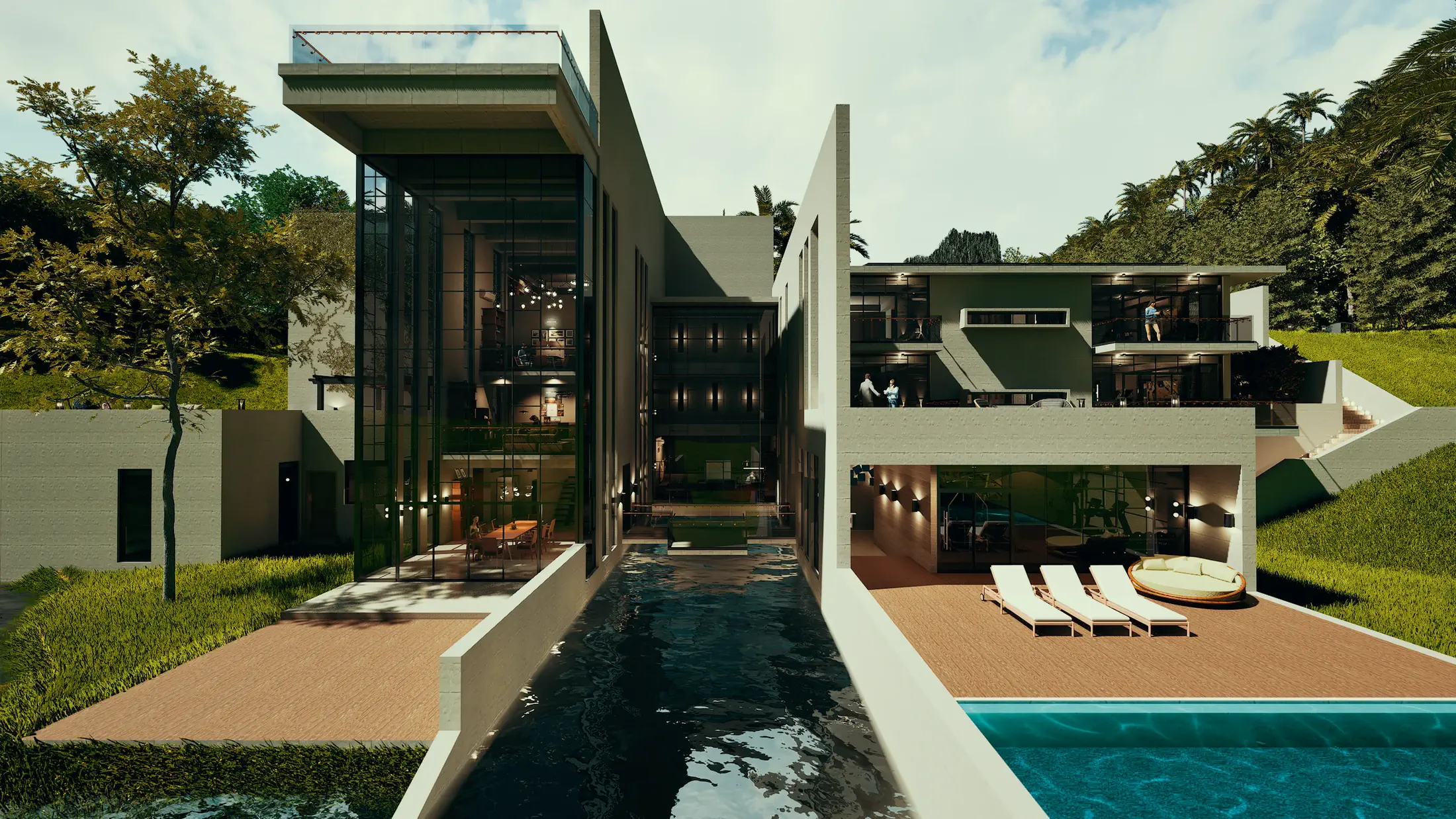
Frontal view from the Kaptai Lake: the section read as south elevation, glazed living rooms stacked above the pool deck, secondary mass and bridge to the right South Elevation from Kaptai Lake
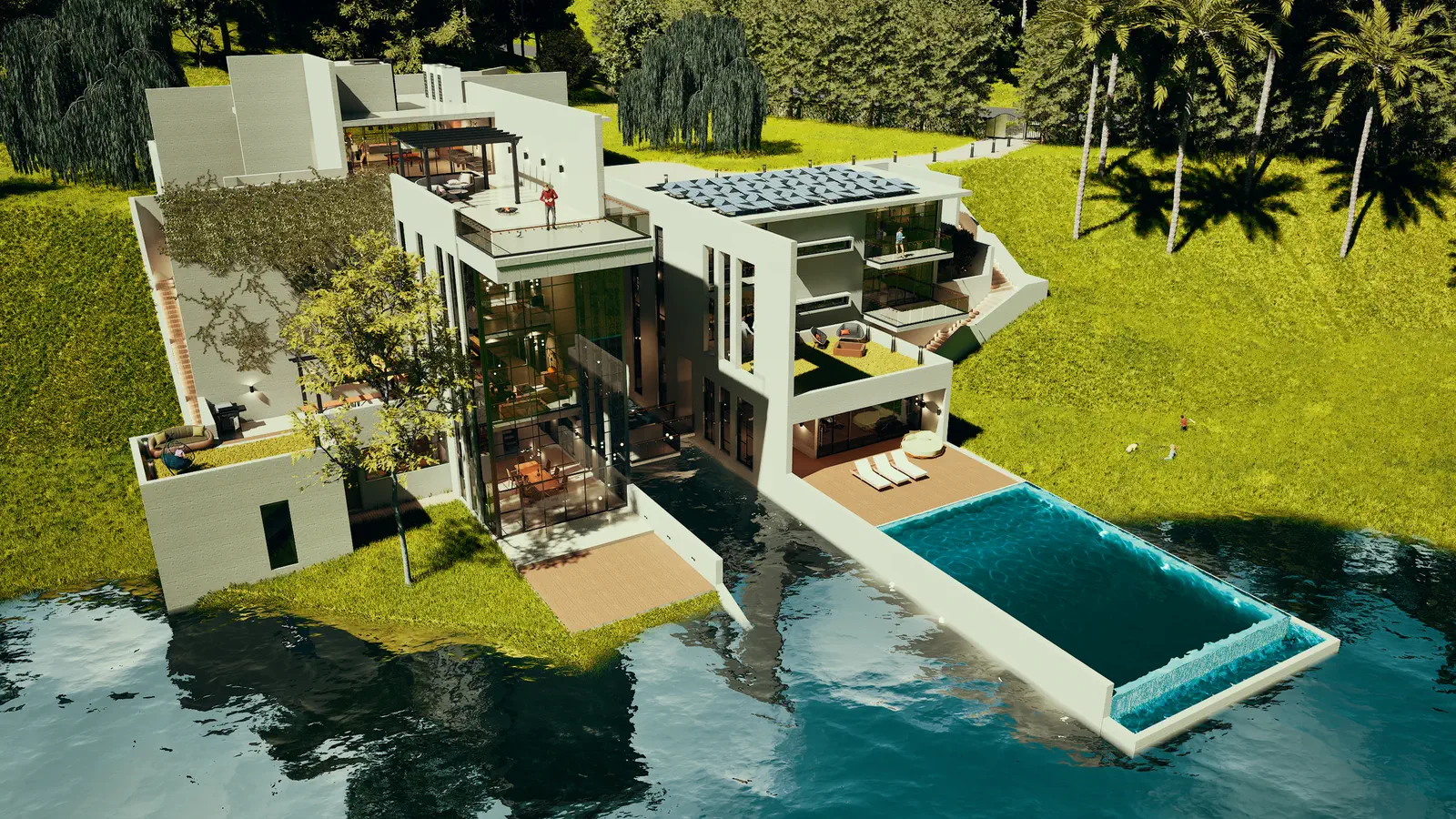
Aerial day view: full south-facing composition with infinity pool extending into the Kaptai Lake, two building masses linked by bridges, rooftop solar array on the kitchen volume Aerial · Day
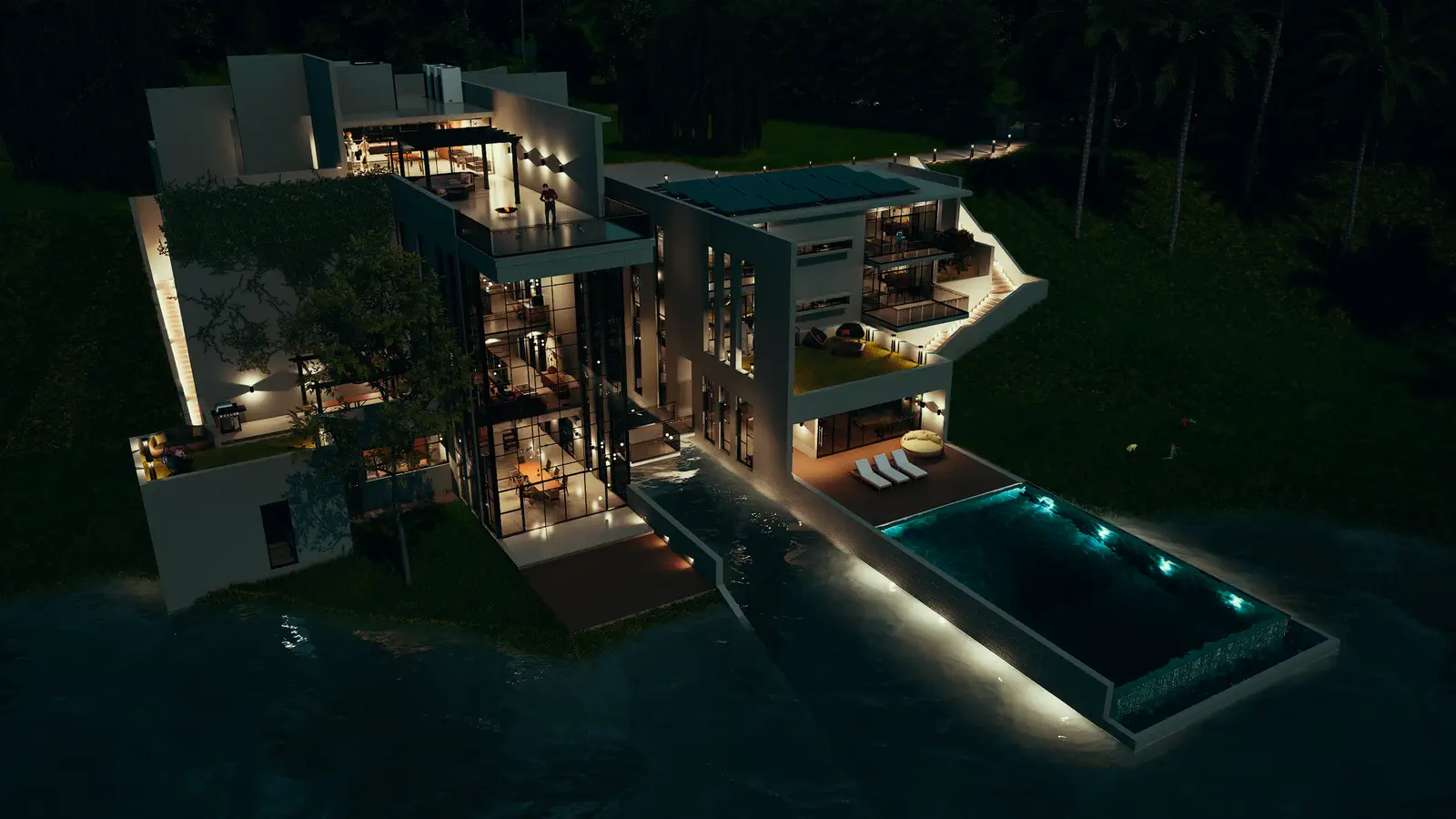
Aerial night view: the same composition lit from within, infinity pool glowing, south-facing terraces and bedrooms warm against the dark hill Aerial · Night

Site, Section

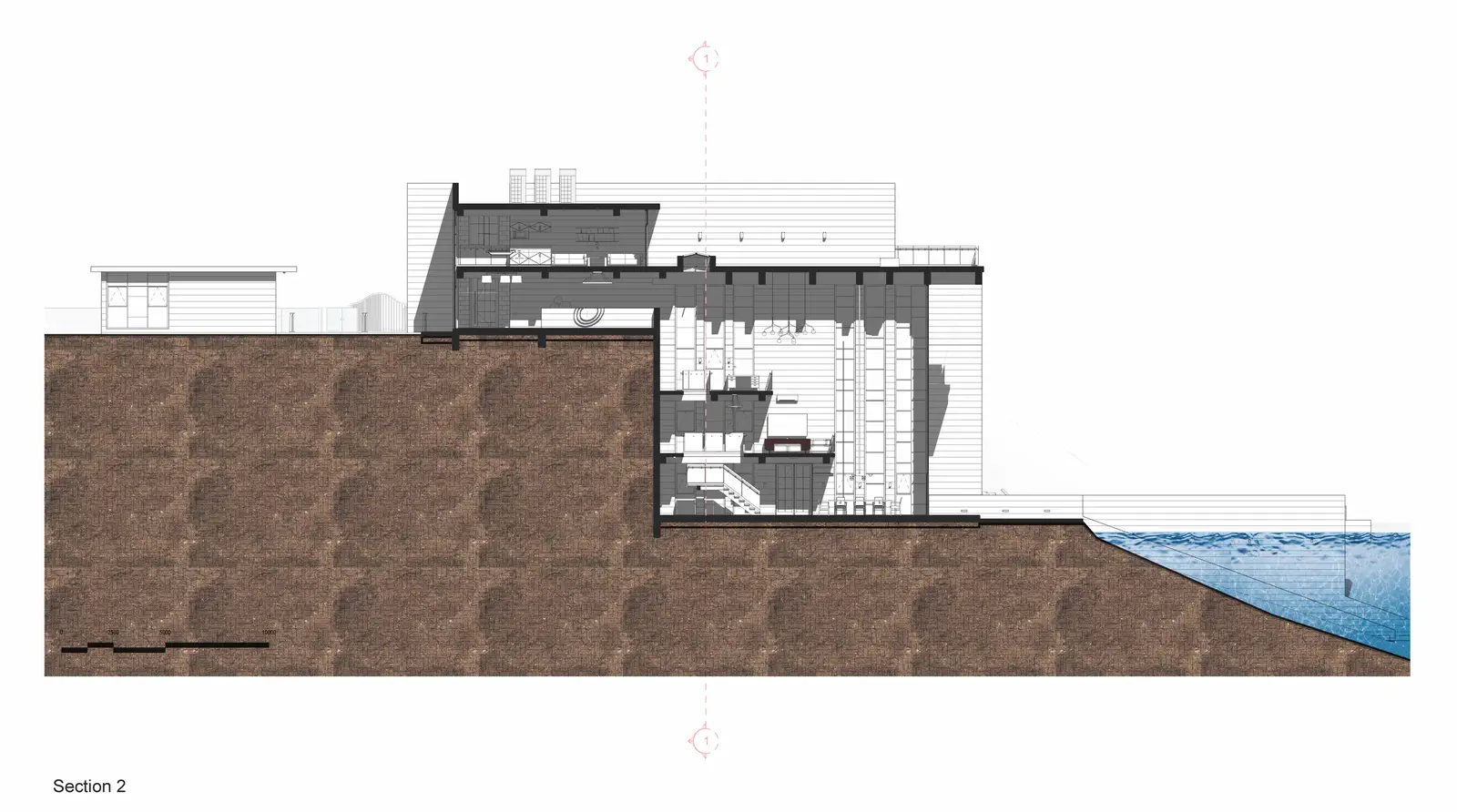
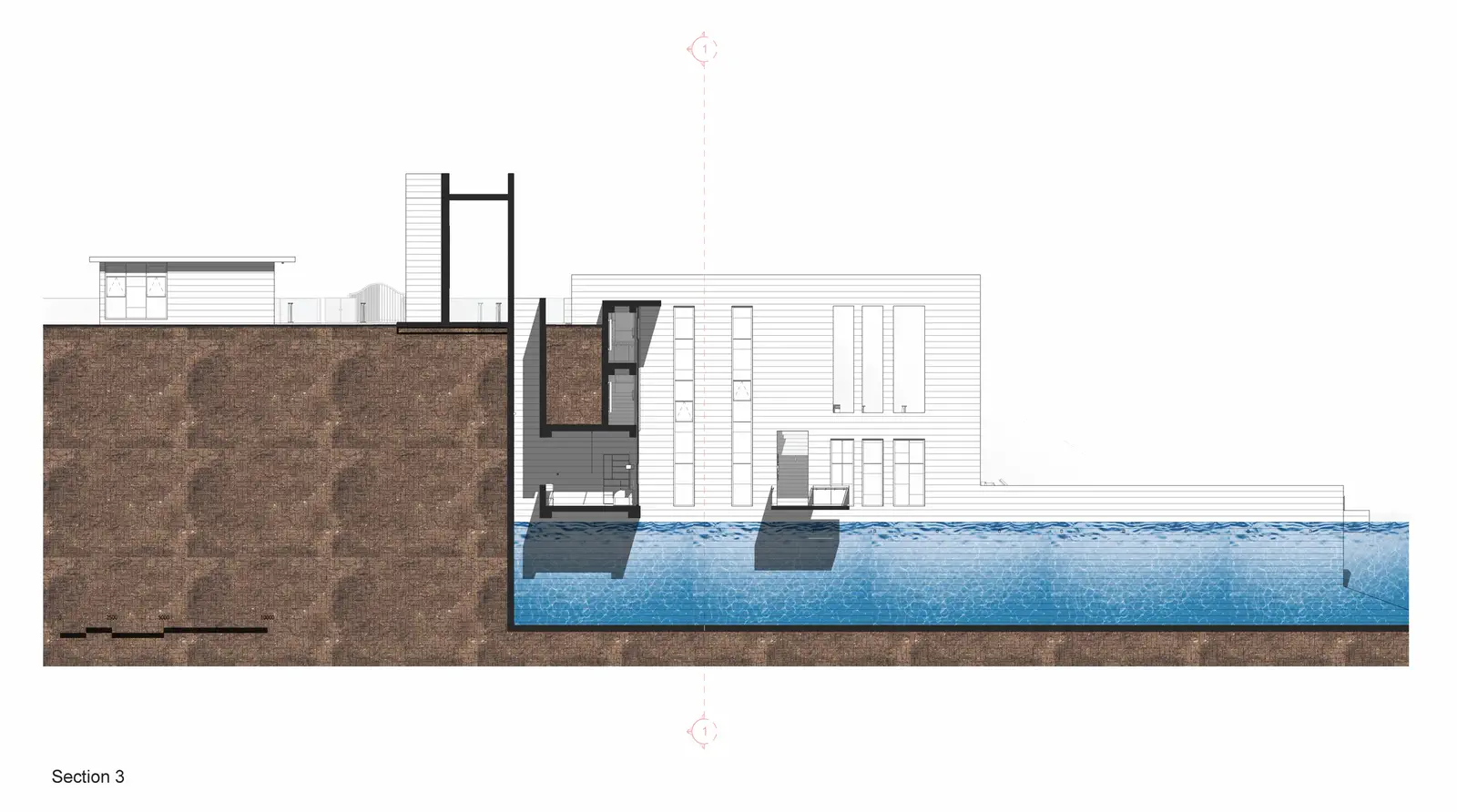
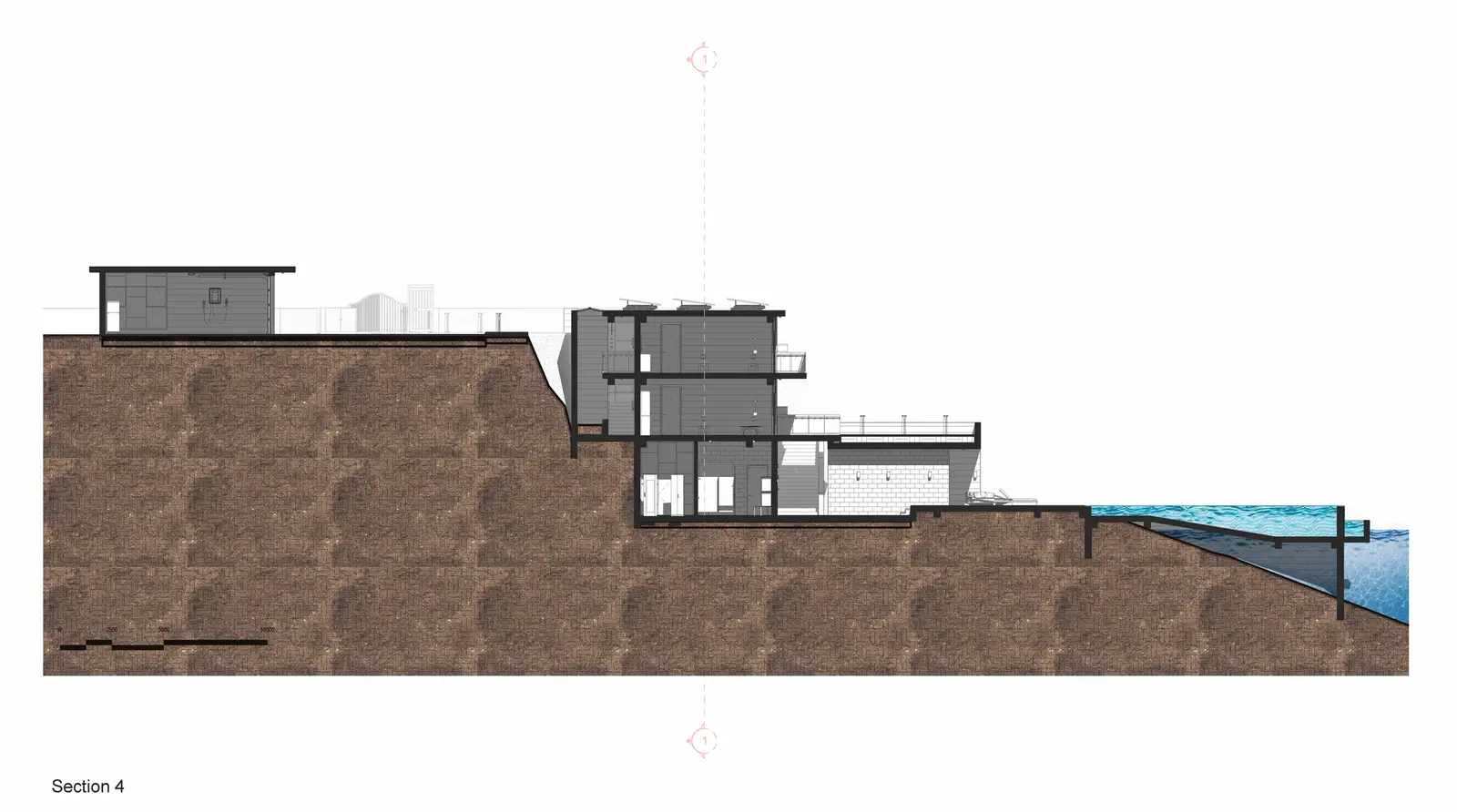
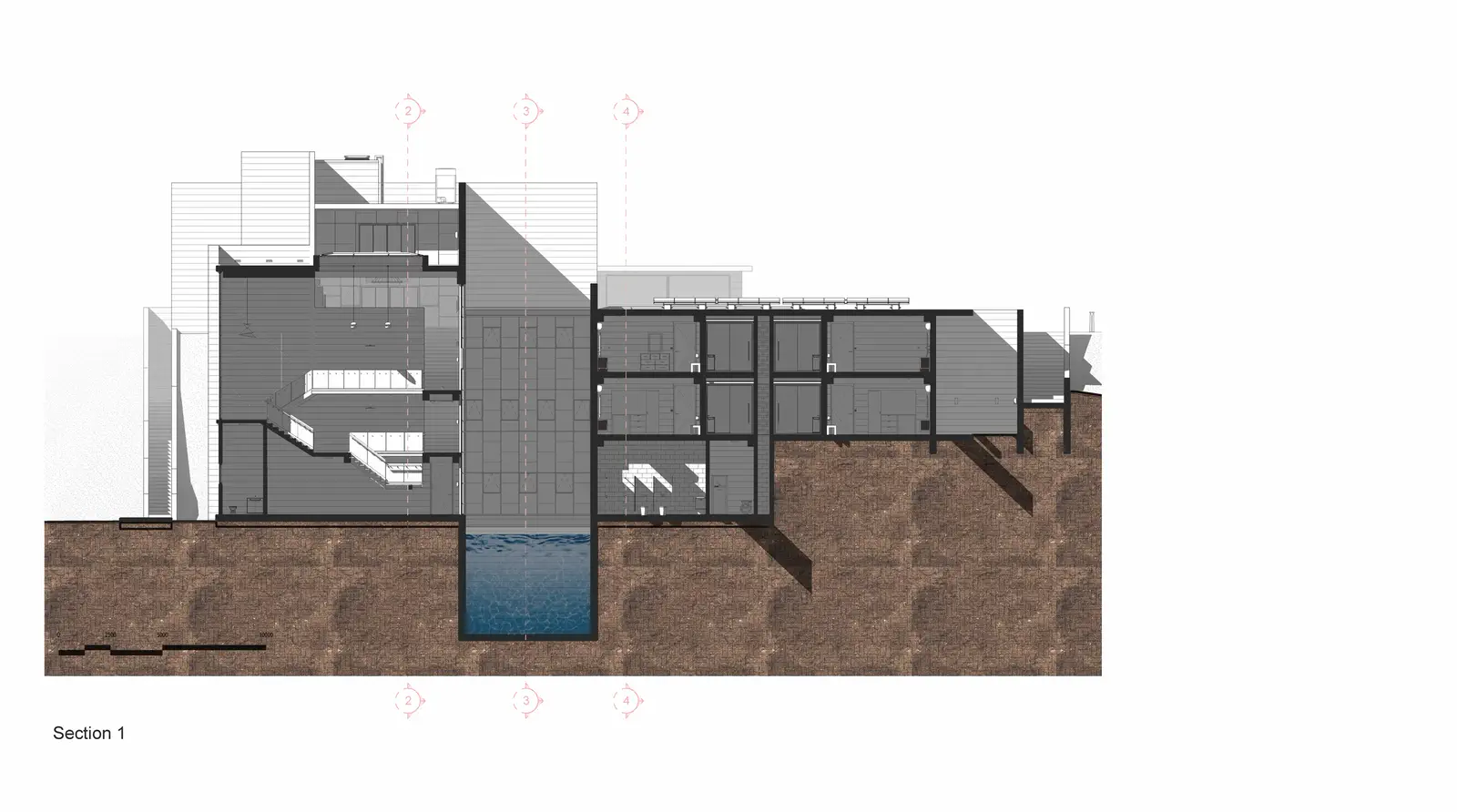
The site plan reads as a single move: a path from the road, sweeping to find the entry, then descending south toward the Kaptai Lake. The four building sections cut at right angles to this descent and document the architectural dialogue with the slope. Each section terminates in either soil or water.
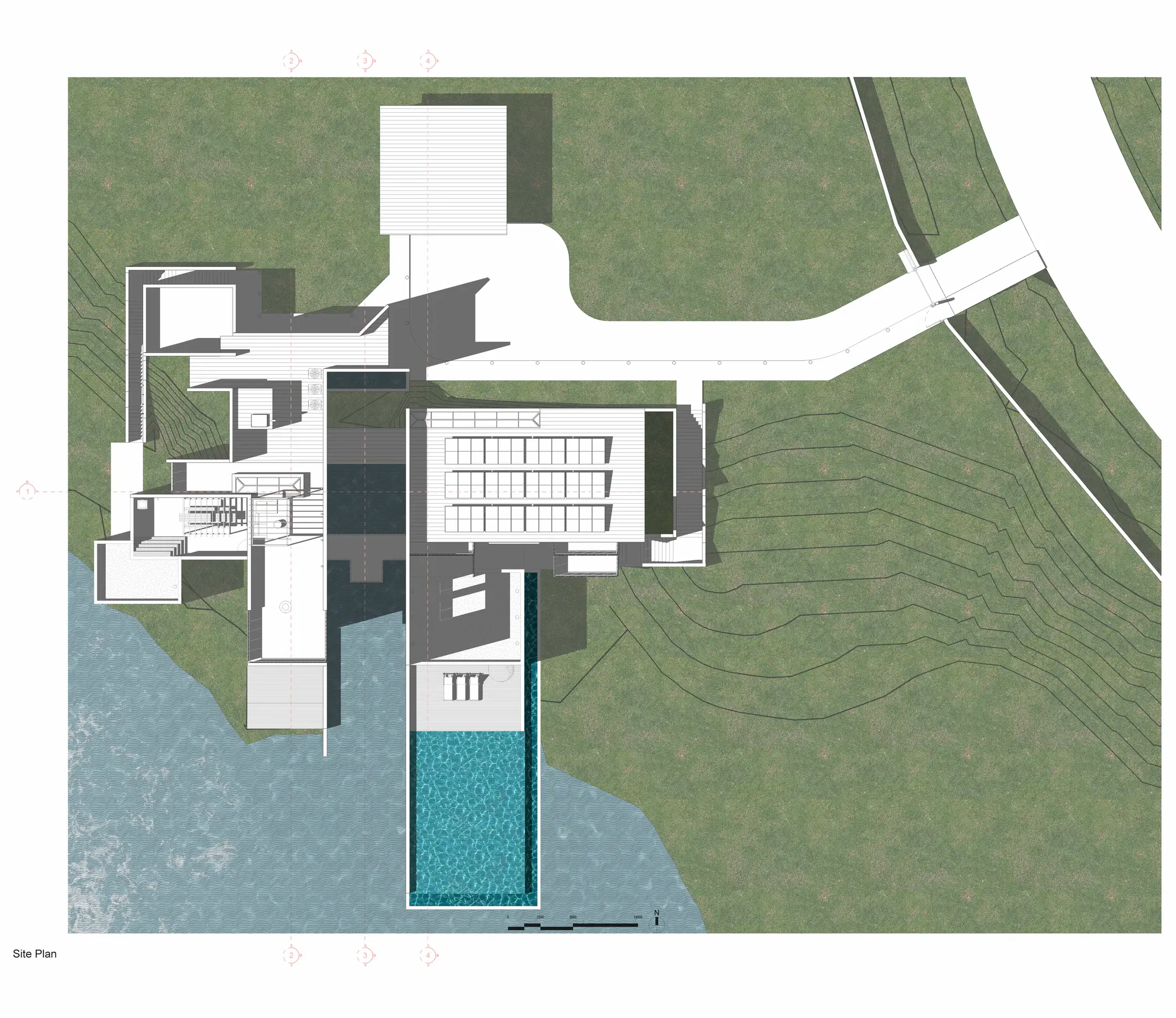
Site plan: house and pool nested into the hillside above the Kaptai Lake, bridge from the upper road to the entry, infinity pool extending south into the lake
Section 1: full vertical cut through the residence, hill on the north, Kaptai Lake to the south, five levels of stepped programme
Section 2: cut through the secondary mass, garage and service quarter buried in the slope, kitchen mass extending toward the lake
Section 3: cut through the pool wing, infinity pool reading as a horizontal line continuing into the Kaptai Lake
Section 4: cut through the bridge connecting the residence to the upper road, hill walls on both sides, courtyard between

Five Levels

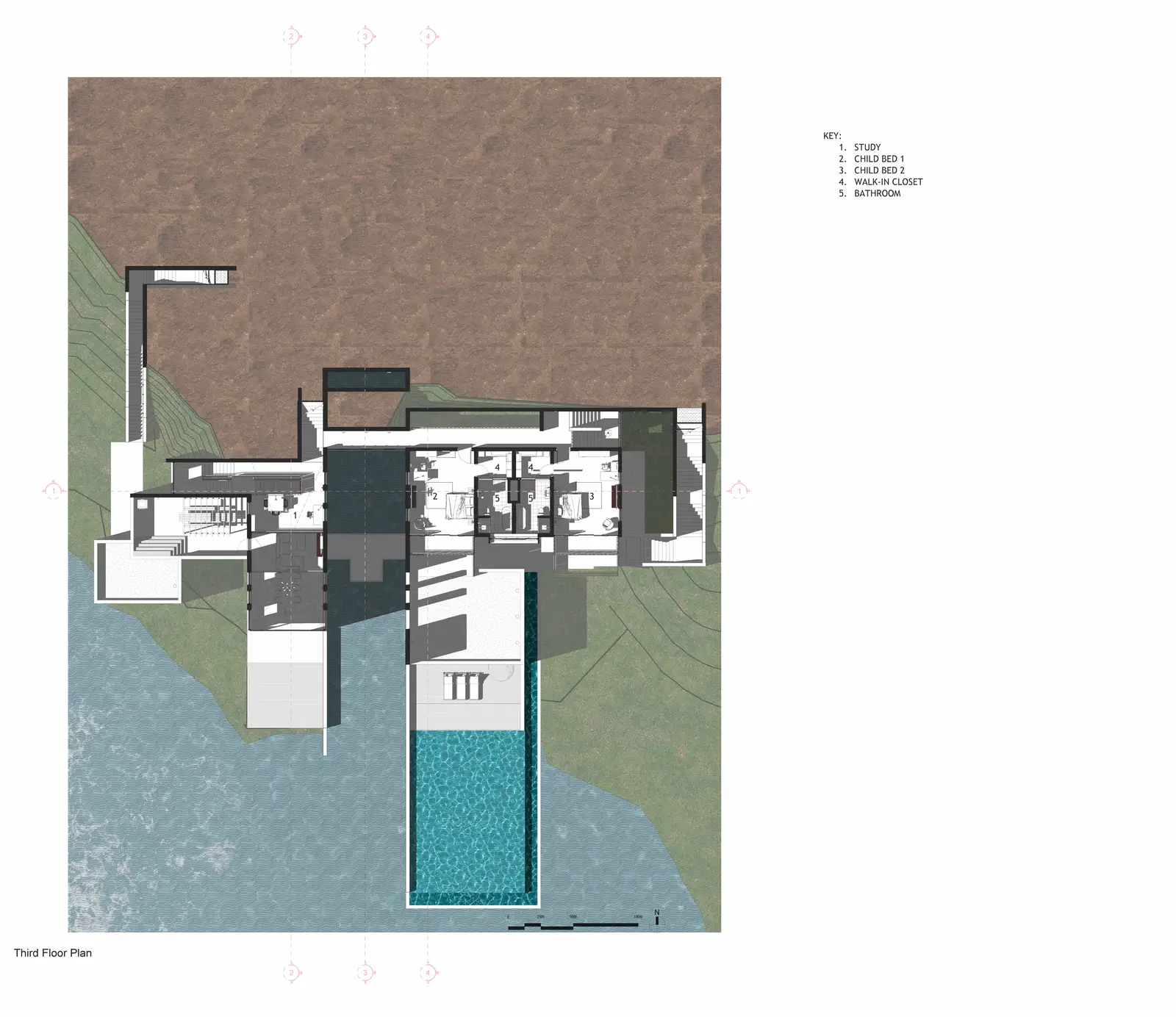
One floor for arrival. One floor for the children's bedrooms and their study. One floor for the family. One floor for the kitchen, the architect's studio, and the water. One floor for the rooftop. The order is the order of the hill, not of the programme. The programme accommodates.
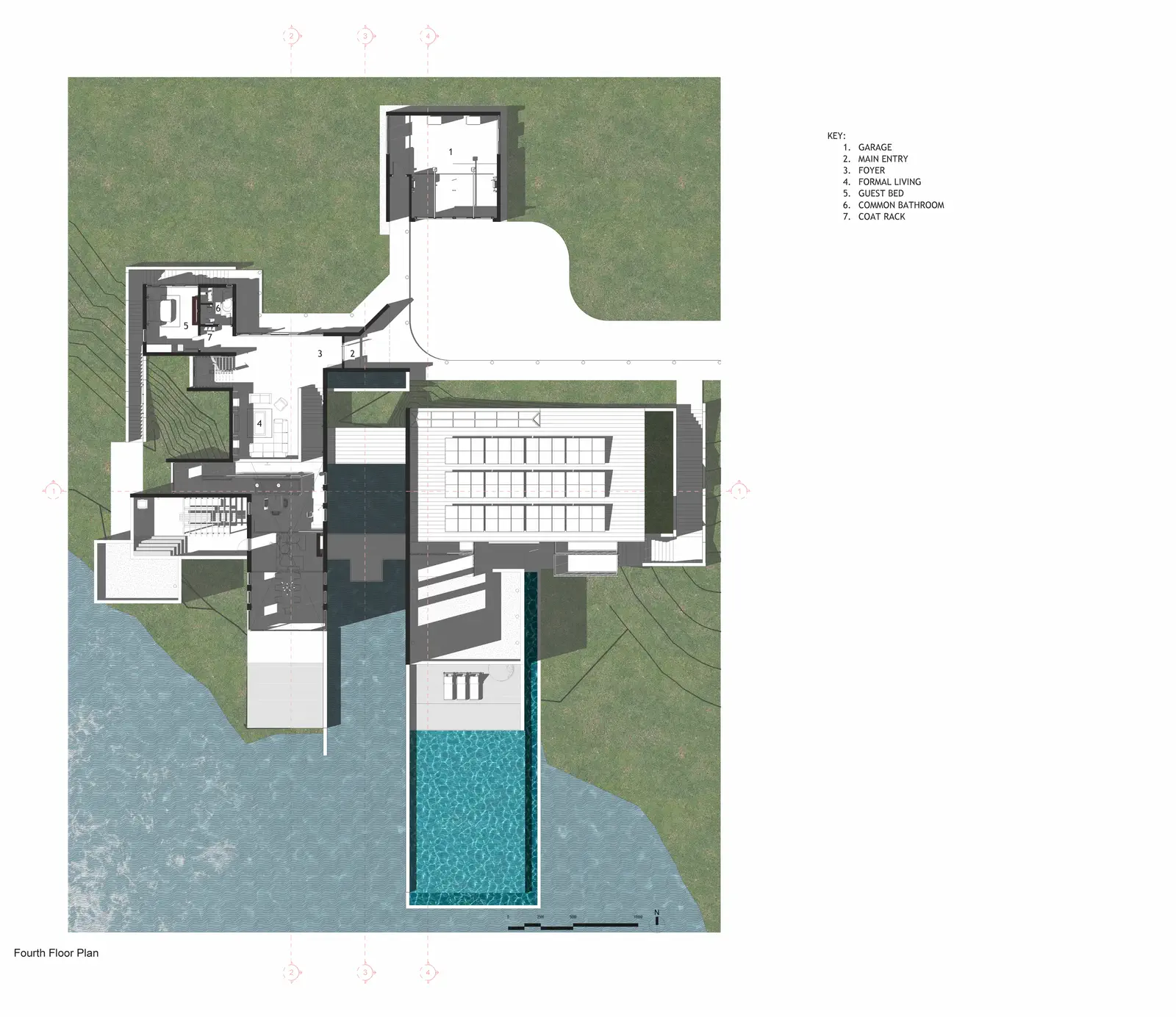
Level 4 plan (street arrival): garage, main entry, foyer, formal living, guest bed, common bathroom, coat rack
Level 3 plan (children's level): children's study, two children's bedrooms, walk-in closet, bathroom
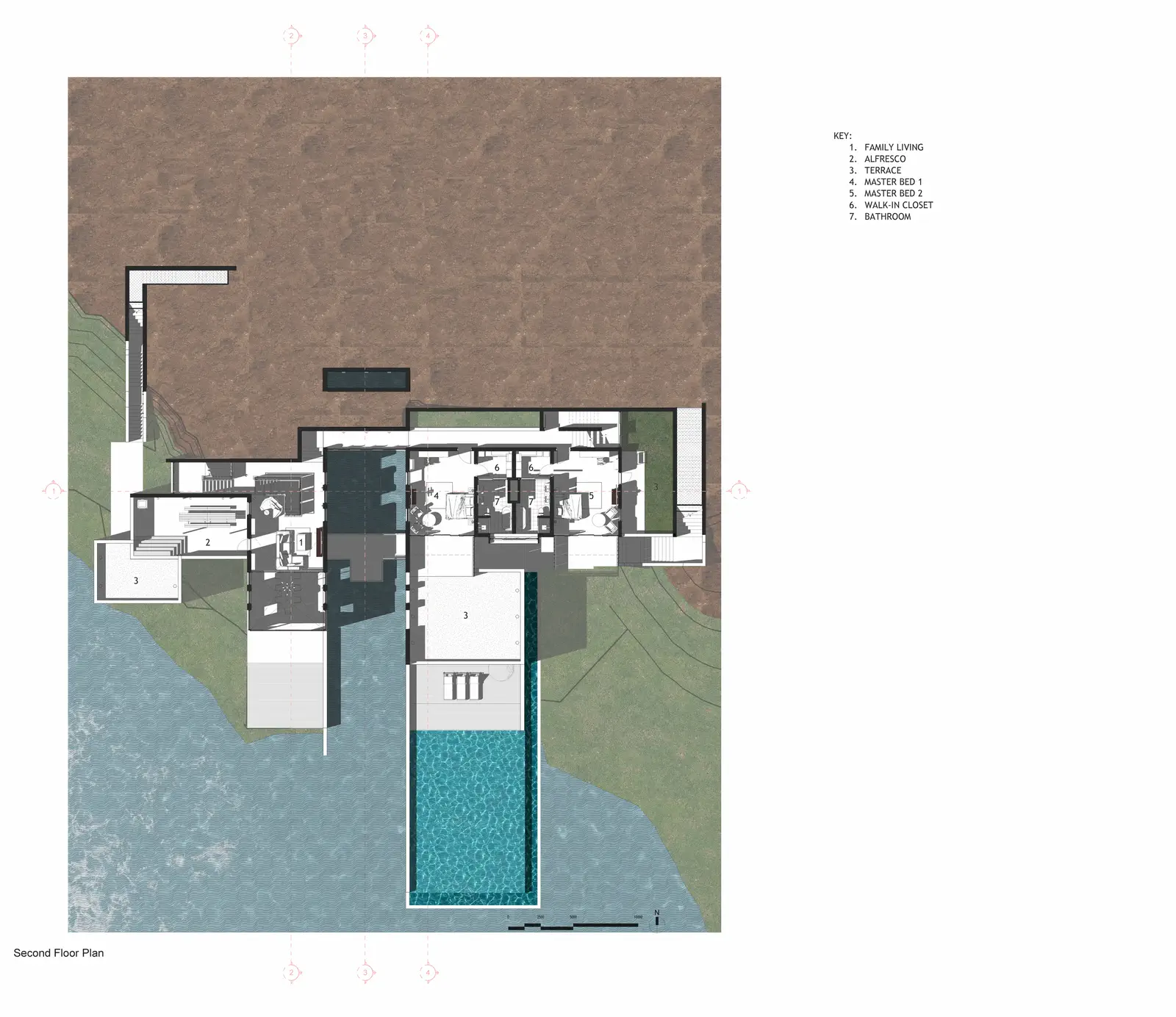
Level 2 plan (the heart): family living, alfresco terrace, two master bed suites, walk-in closets, bathroom
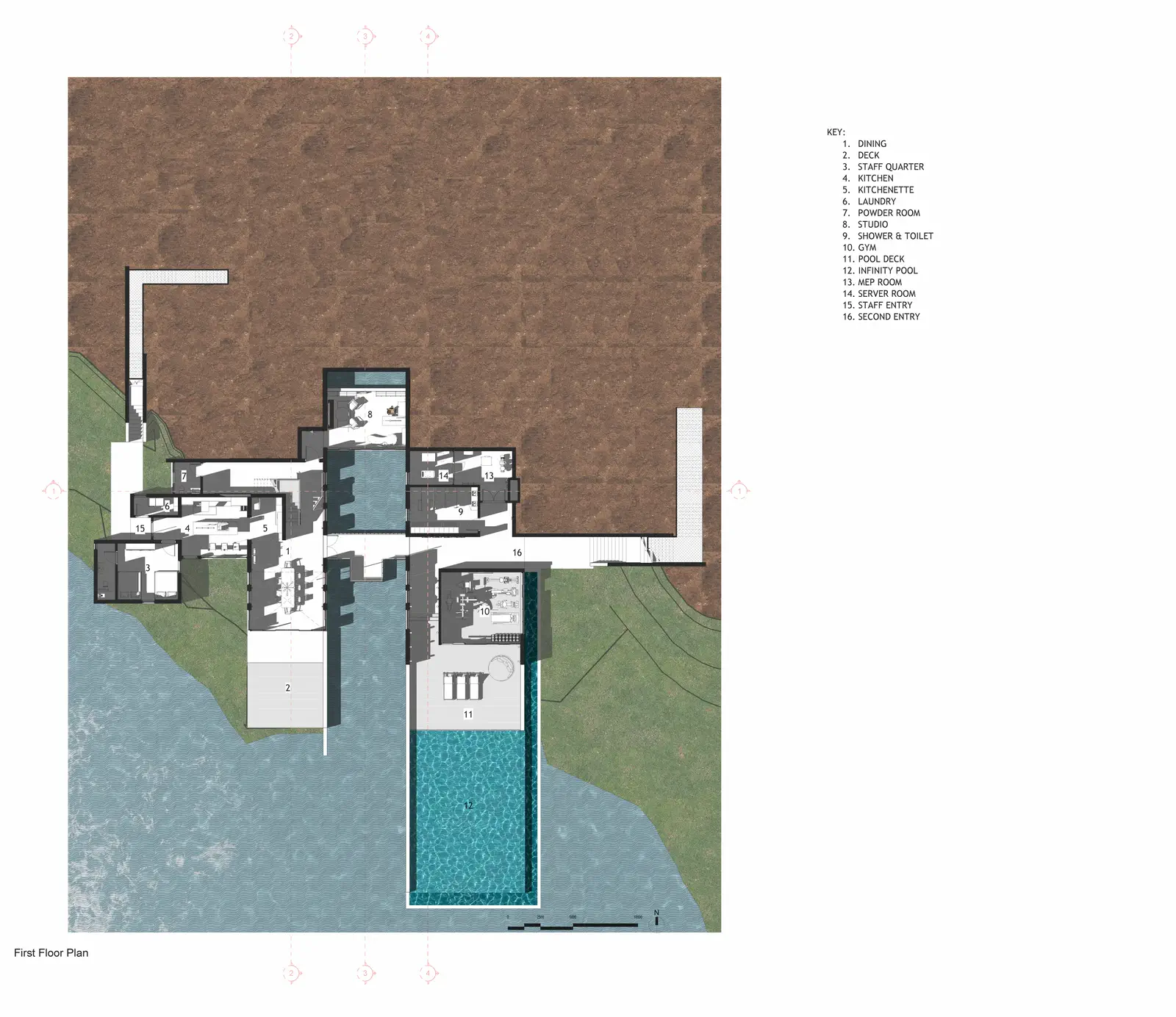
Level 1 plan (water level): dining, deck, kitchen, kitchenette, laundry, powder room, architect's studio, shower and toilet, gym, pool deck, infinity pool, staff quarter, MEP and server rooms, staff entry, second entry
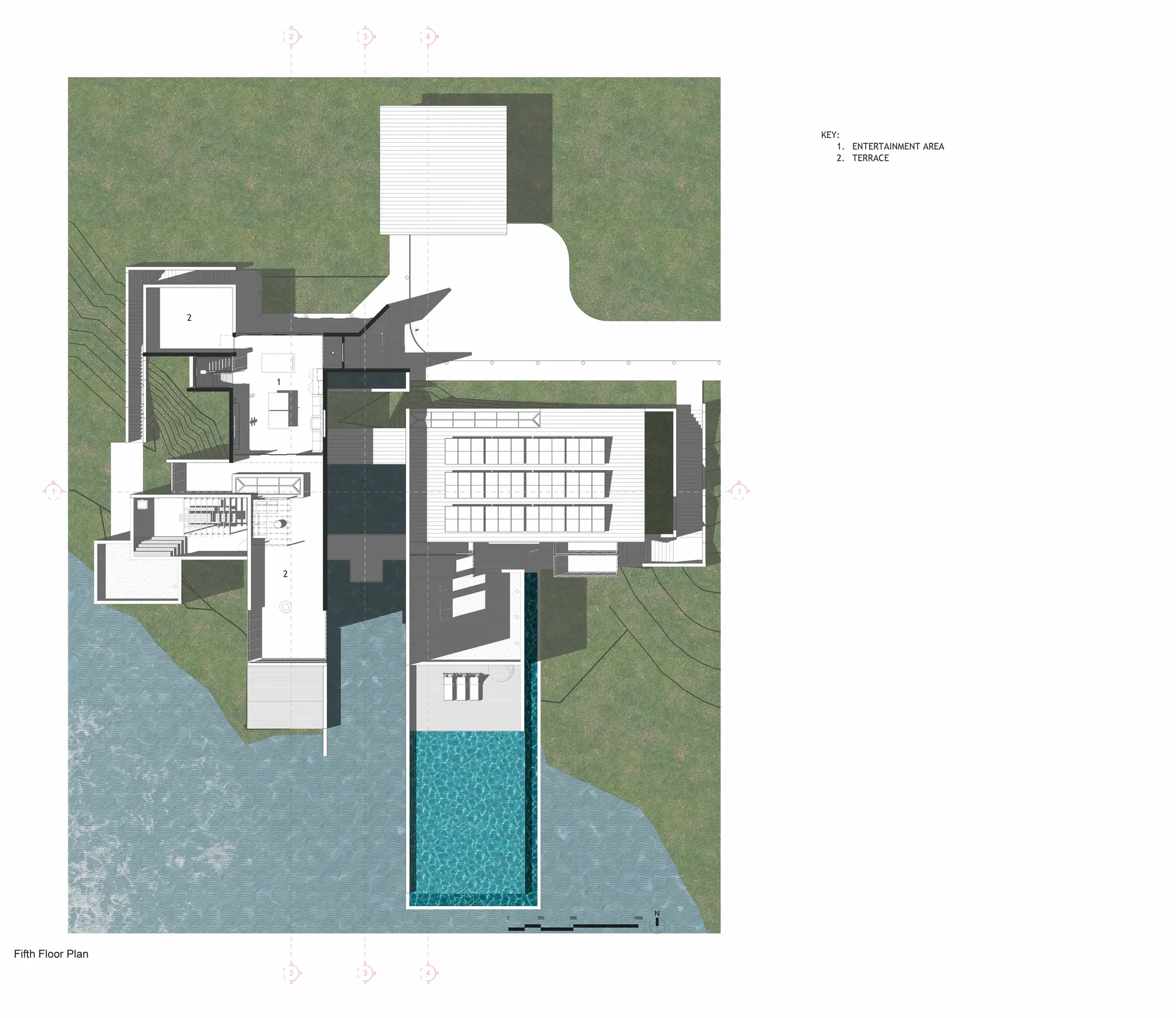
Level 5 plan (rooftop): entertainment zone and roof terrace at the highest tier of the section

The Public Heart

The shared rooms face south. The four-storey window on the Kaptai Lake is the defining vertical gesture of the project: dining at the bottom, family living above it, children's study above that, formal living at the top. Each level opens onto the same sky and the same water through the same aperture. The atrium between them is a vertical room in its own right, the home's interior threshold.
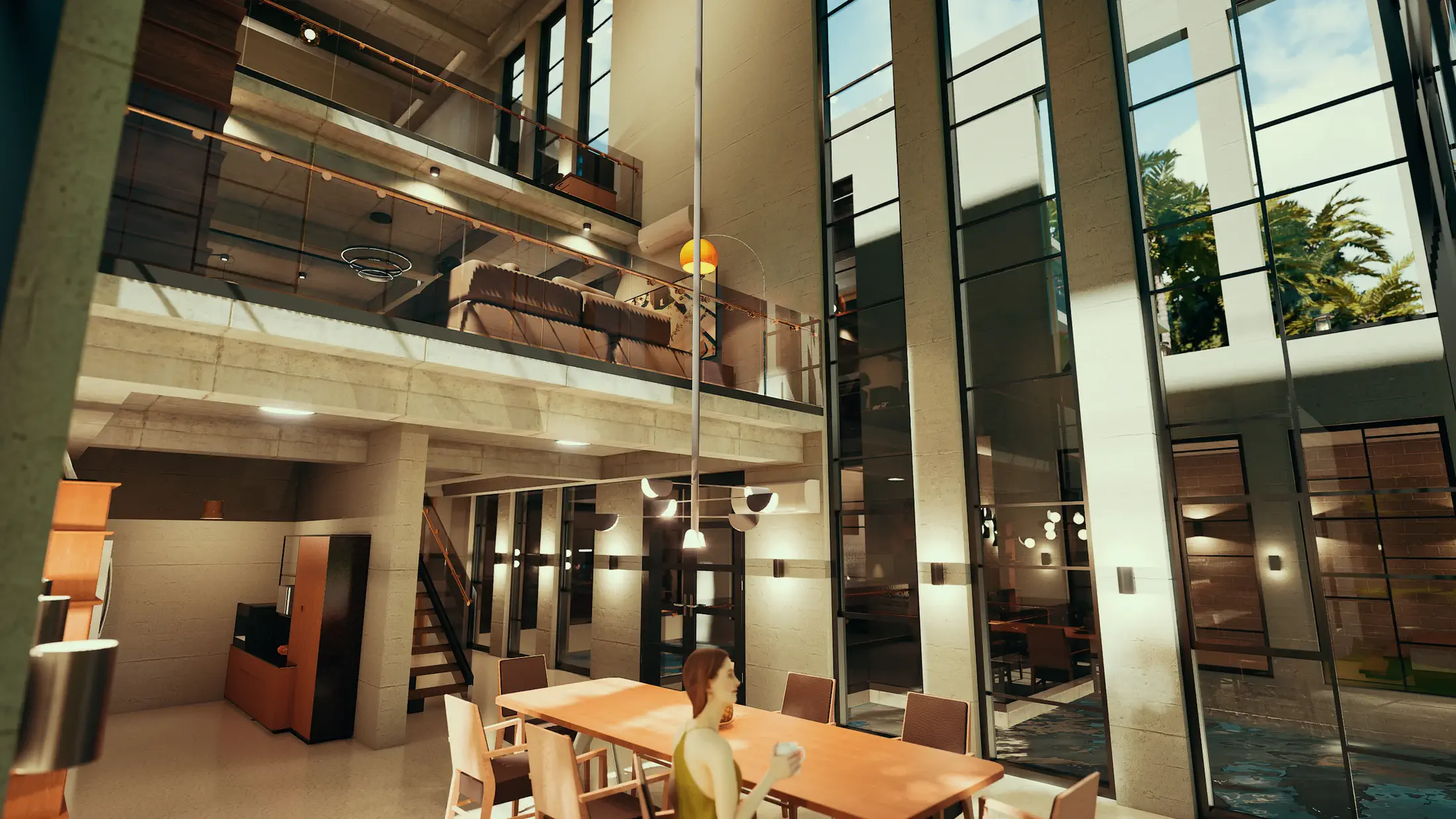
View from the dining space at the foot of the four-storey atrium: family living one level above, children's study above that, full-height south-facing glazing onto the Kaptai Lake Four-Storey Atrium · Dining to Formal Living
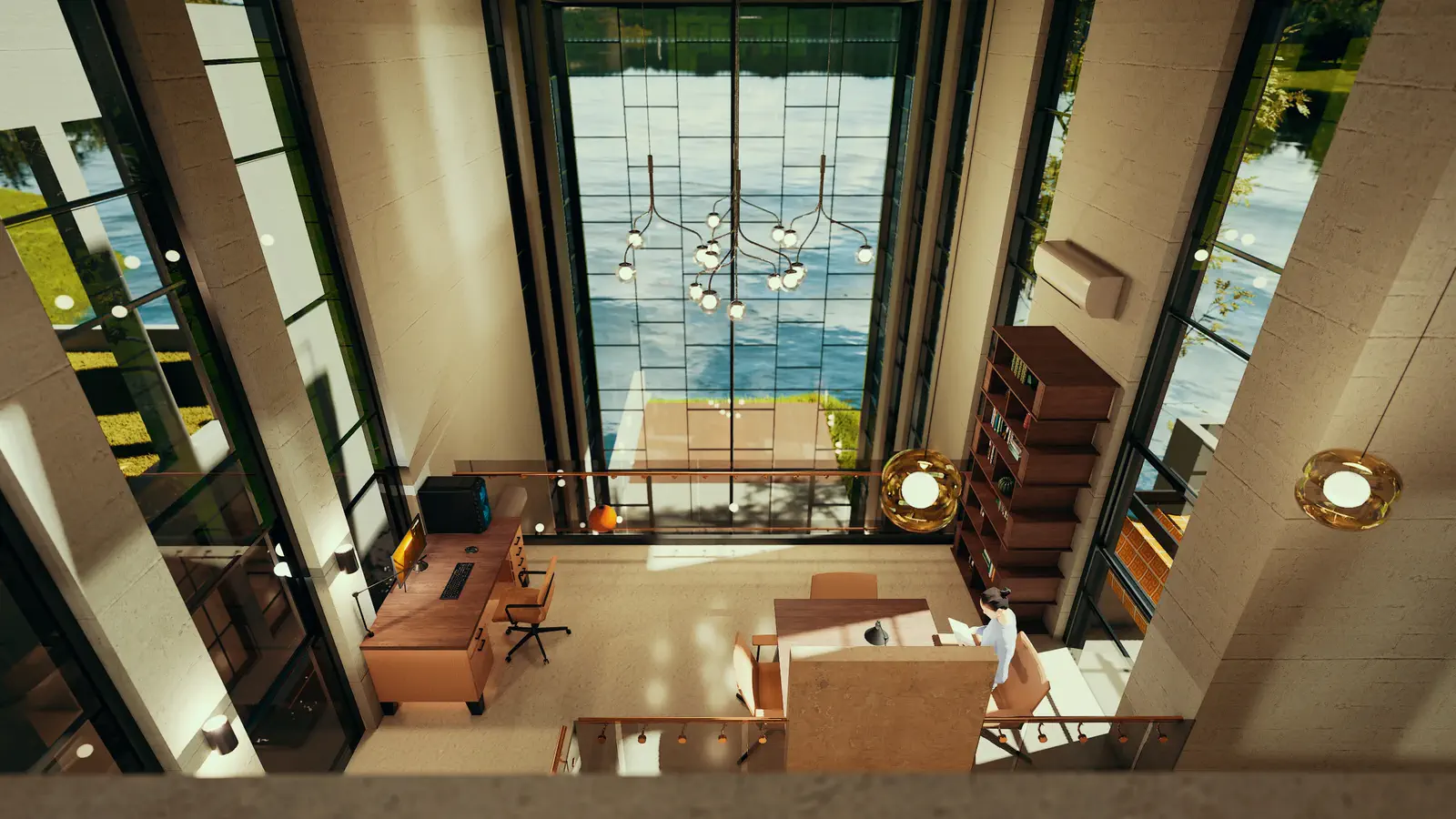
Children's study at Level 3 viewed from the formal living above: the four-storey atrium section reading downward, Kaptai Lake beyond the south glazing Children's Study · Level 3
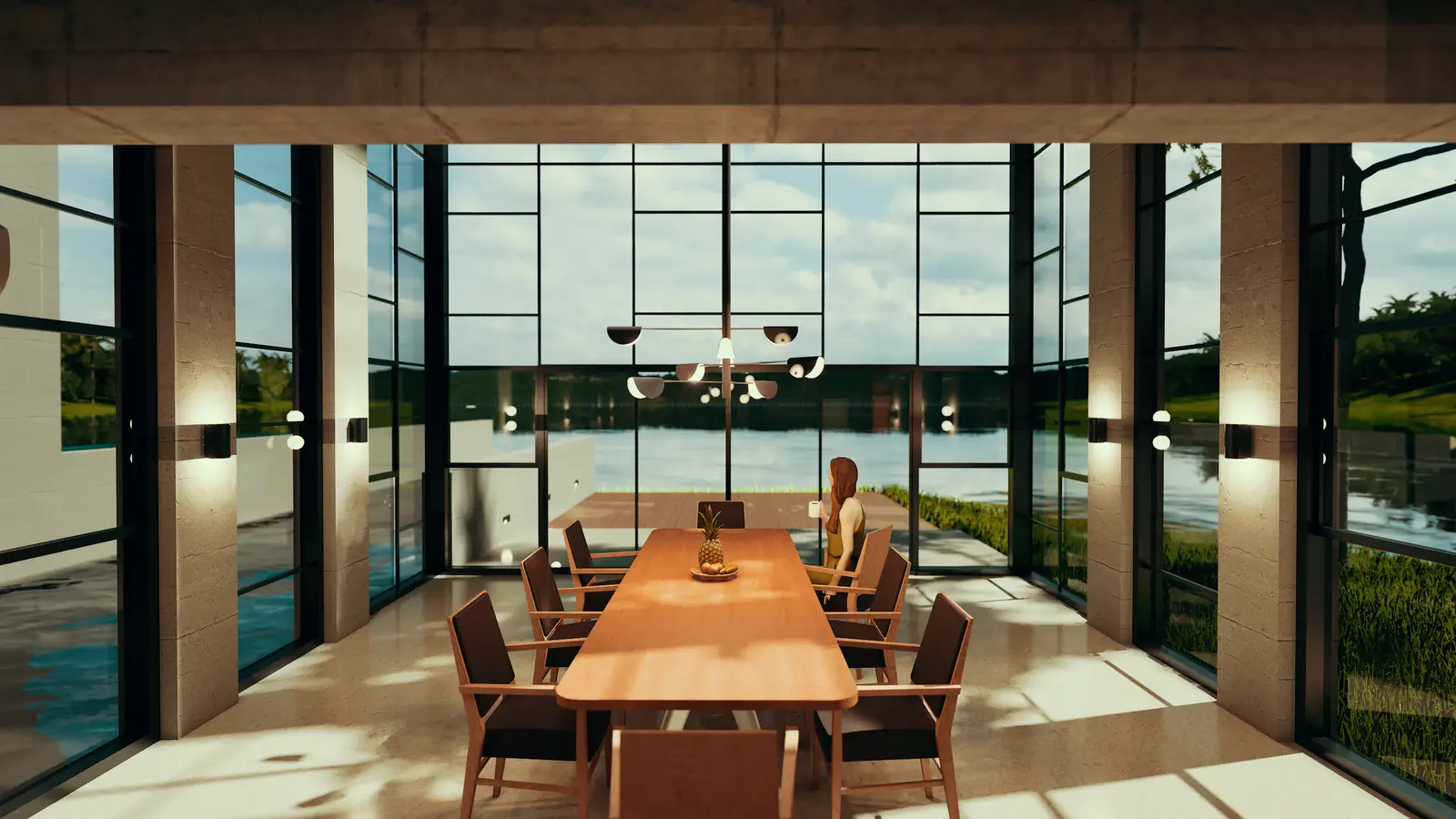
Dining at Level 1: long timber table beneath chandelier, full-height south-facing glazing framing the Kaptai Lake at evening Dining · Level 1
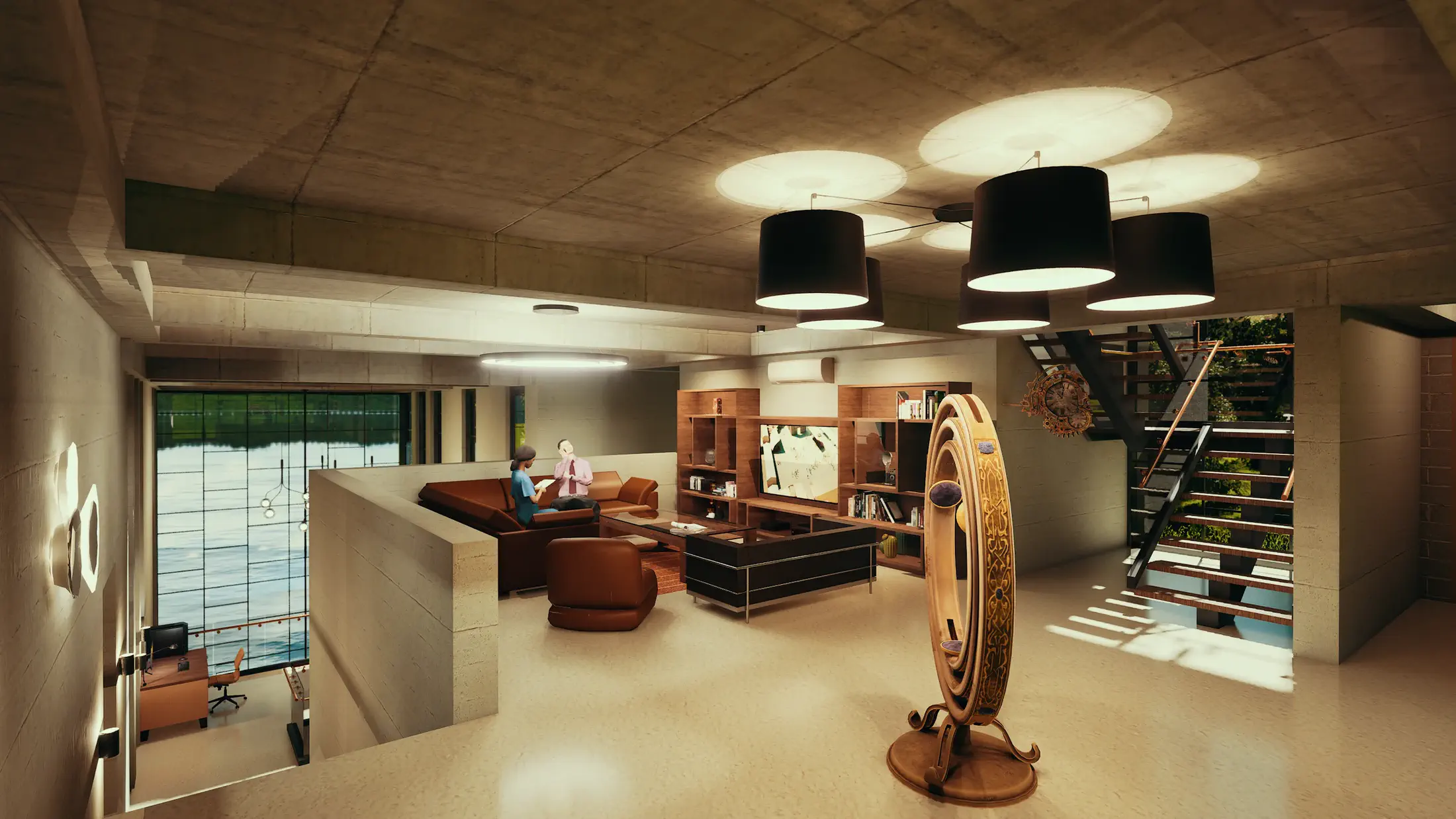
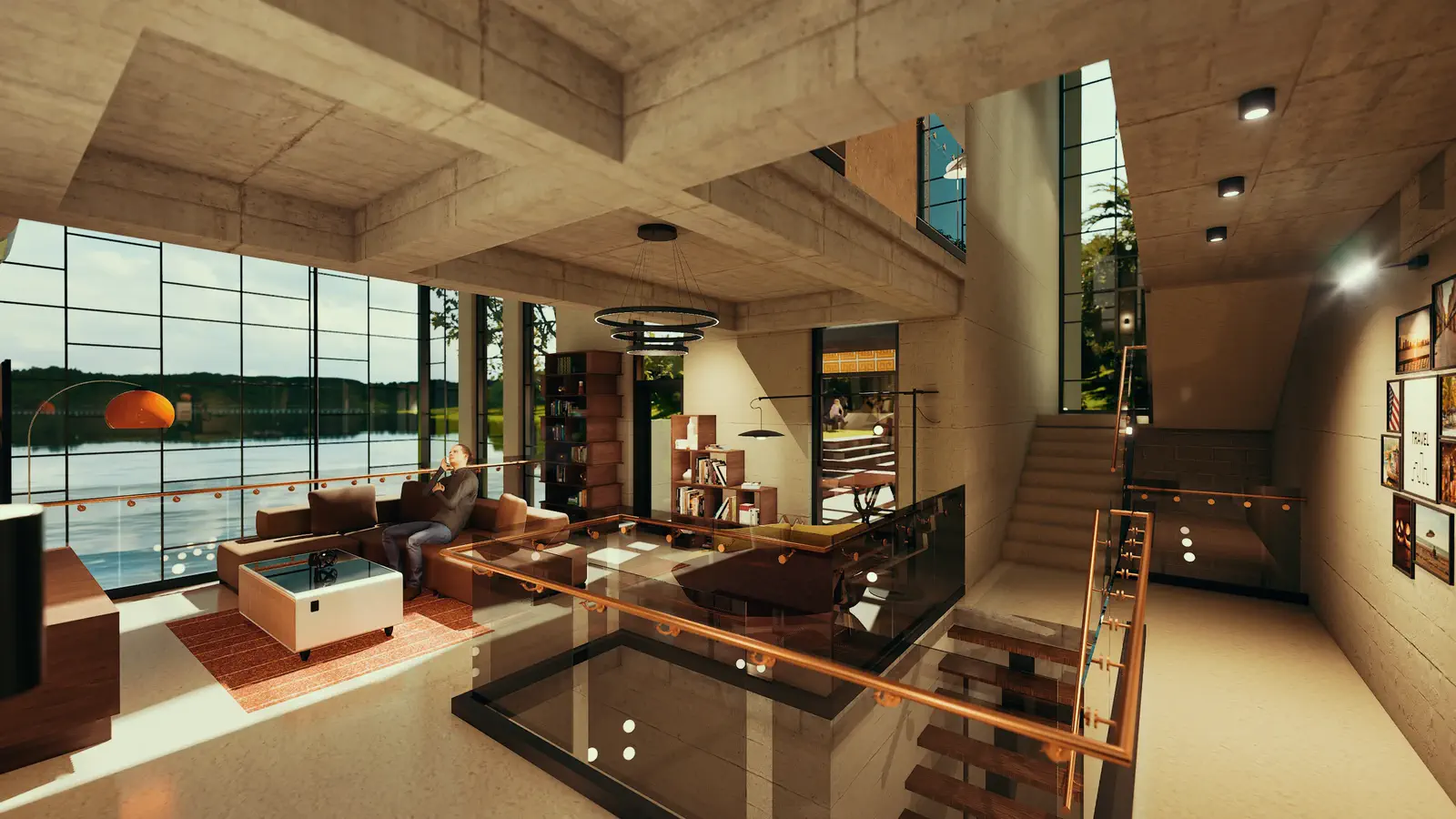
Family living at Level 2: concrete coffered ceiling, casual seating on the south lake side, stair rising to the next tier, ring chandelier centred Family Living · Level 2
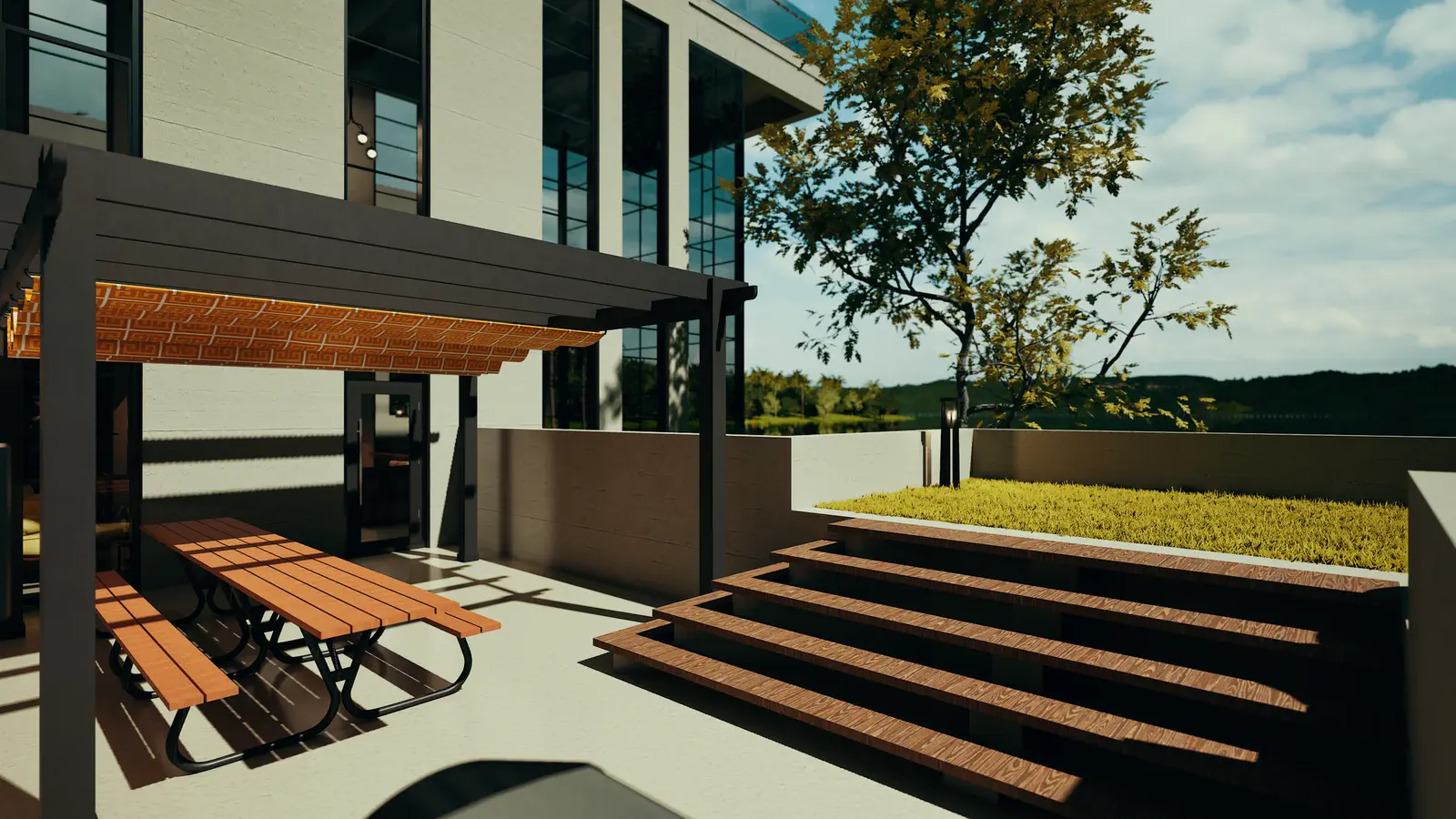
Level 2 alfresco: outdoor terrace off the family living, south-facing toward the Kaptai Lake, partially shaded by the floor above Alfresco · Level 2

The Private Sanctum

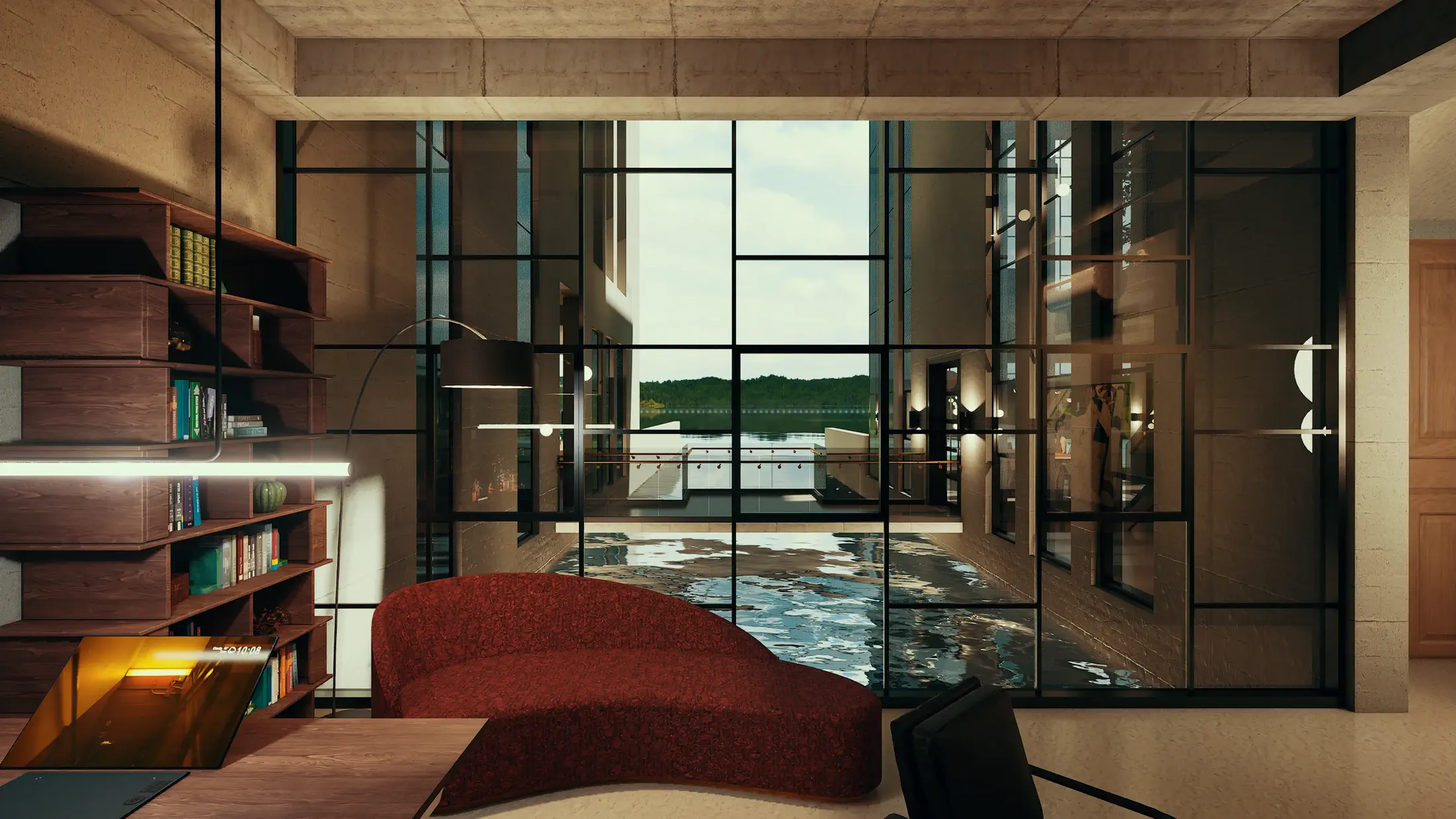
The bedrooms turn inward. The two master bed suites sit at Level 2, oriented south. The architect's studio occupies Level 1, a room that floats between the living block and the sleeping block, above the water. The kitchen is the working hearth: counters in stone, light from the south, the family's everyday choreography.
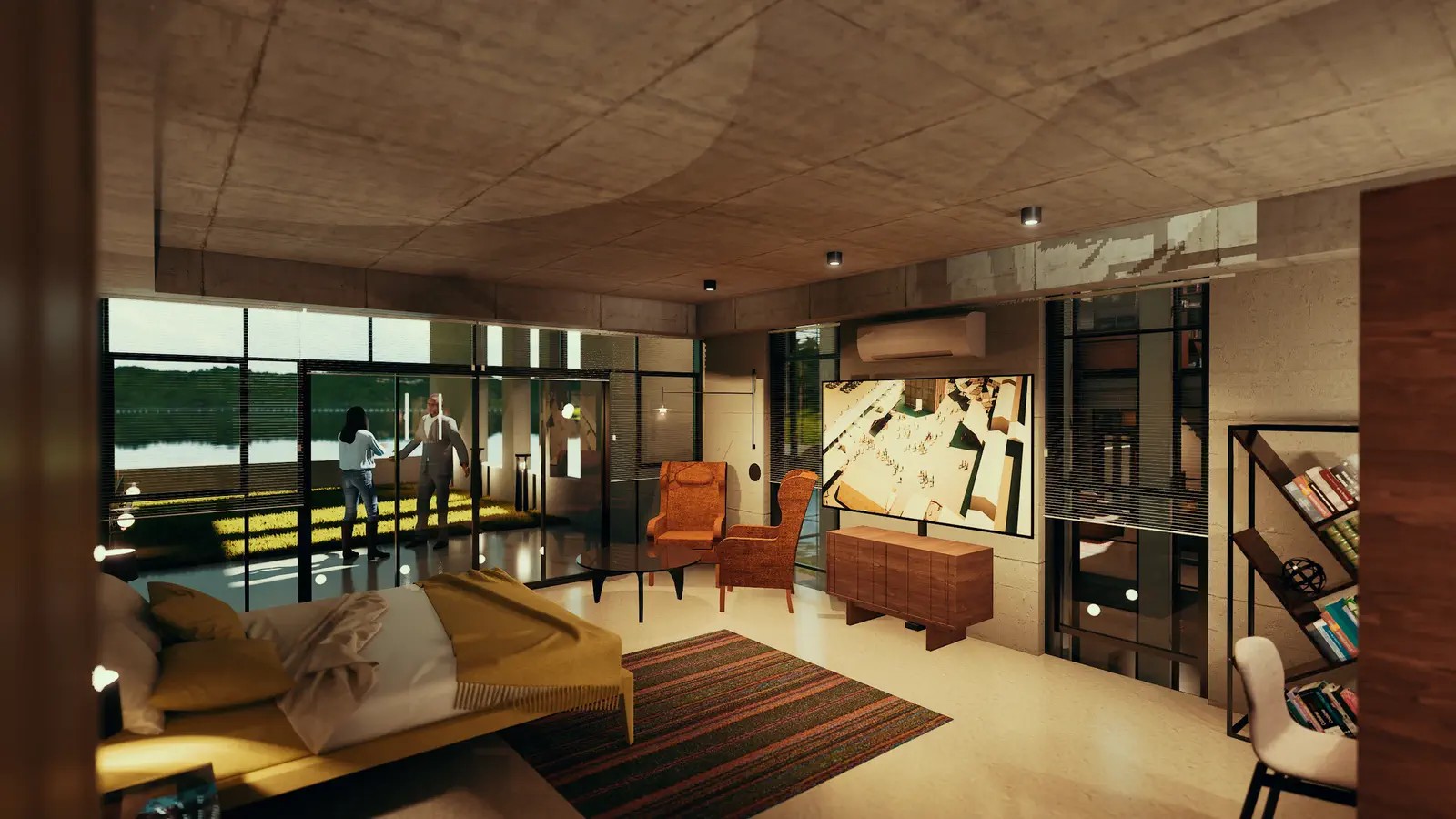
Main bedroom: low timber bed, art panel, south-facing full-height glazing onto the Kaptai Lake, evening light Main Bedroom · Level 2
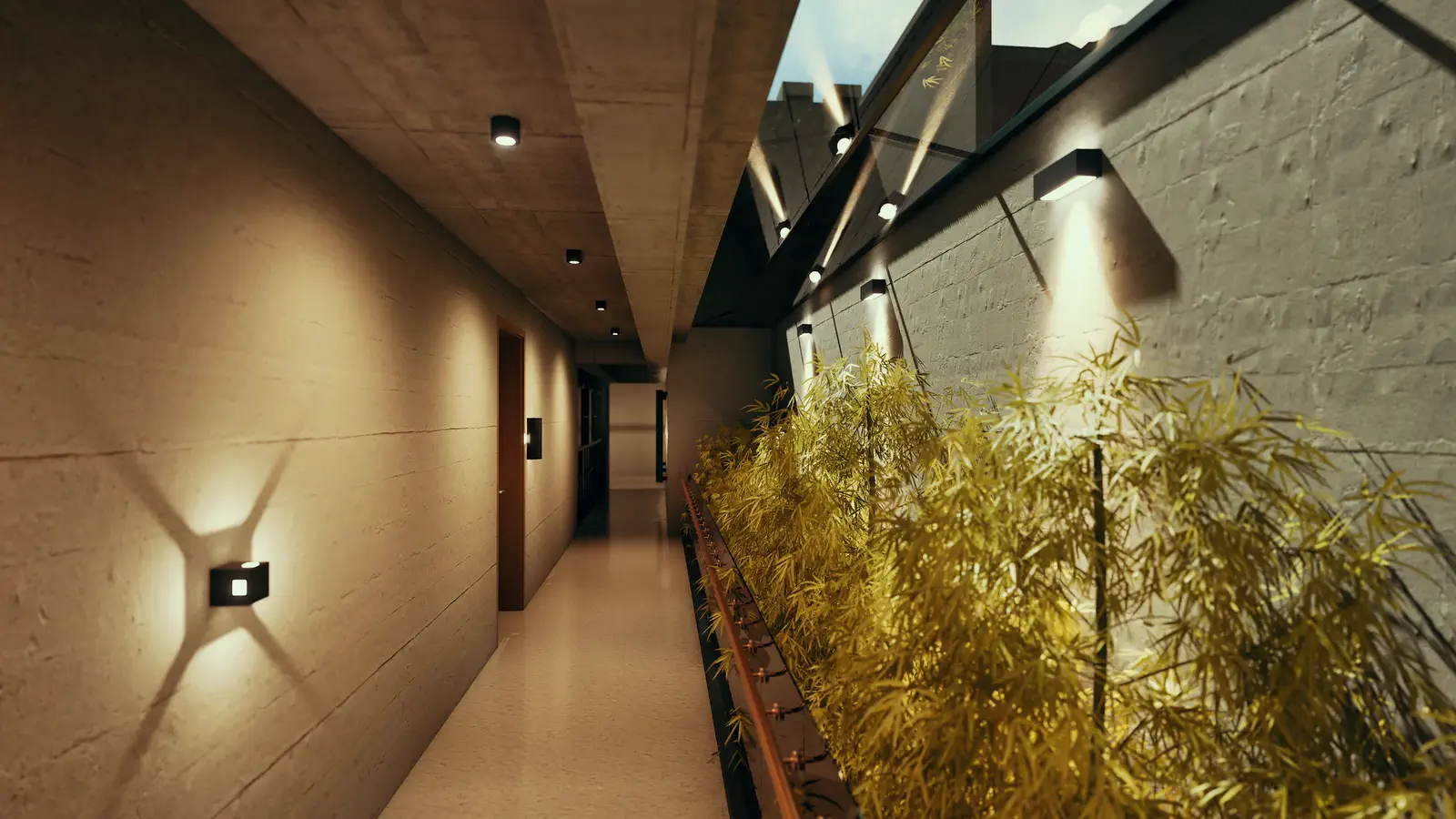
Bedroom corridor with bamboo planter: internal passage with uplit wall sconces and a continuous bamboo light wash to one side Bedroom Corridor
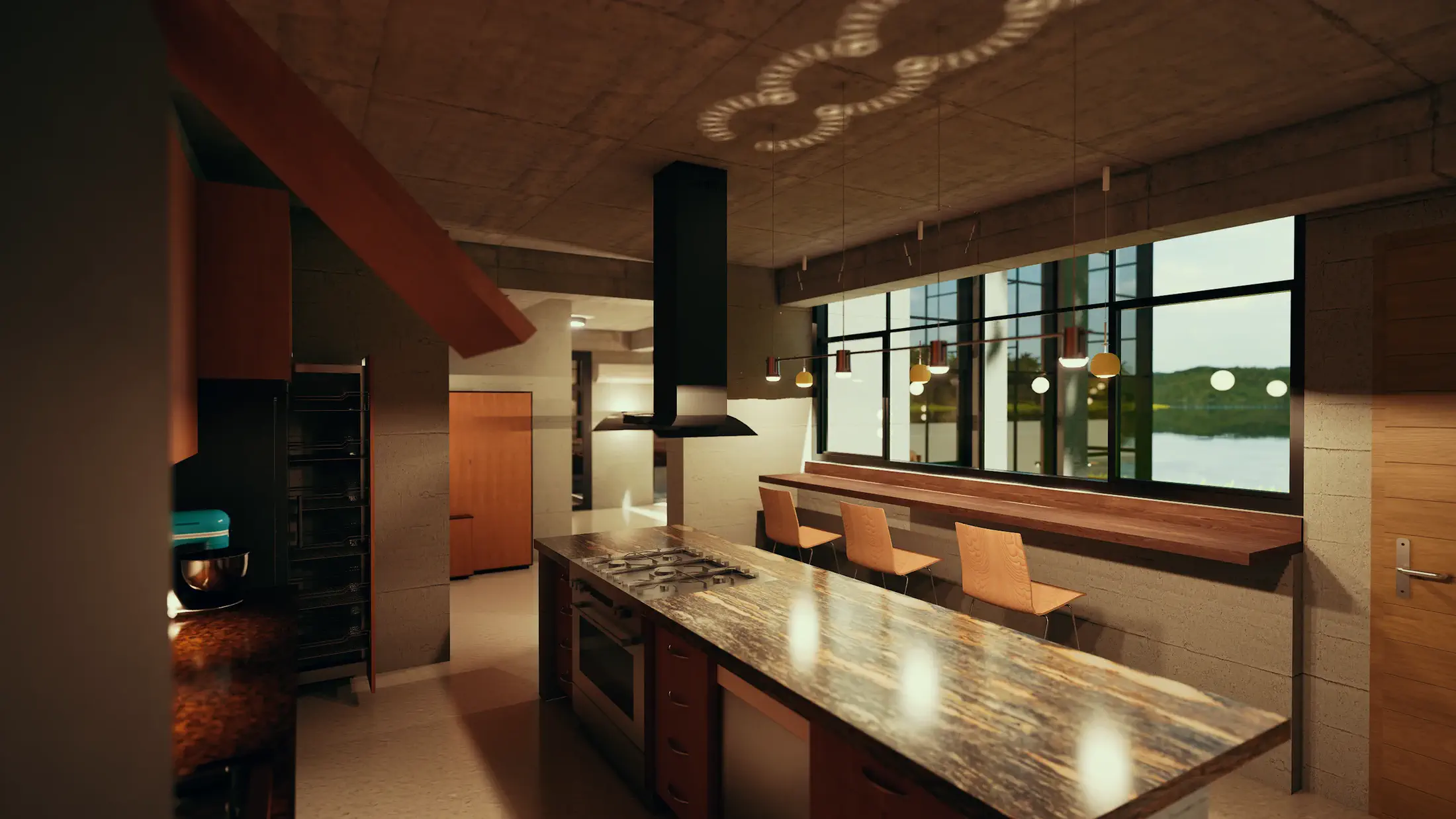
Kitchen at Level 1: marble island with breakfast bar, range below extractor hood, south-facing ribbon window onto the Kaptai Lake Kitchen · Level 1
Architect's studio at Level 1: floating between the living block and the sleeping block above the water, south-facing glazing extending to the Kaptai Lake Architect's Studio · Level 1

Sky and Water

The section terminates in two horizons. At the top, the rooftop returns to sky: an entertainment zone, an open terrace, a pergola and a fire bowl, a skylight cut to read down into the dining room four floors below. At the bottom, the architecture meets the Kaptai Lake without ceremony: a thin slab, a pool deck, a continuation of the floor as a horizontal line into water.
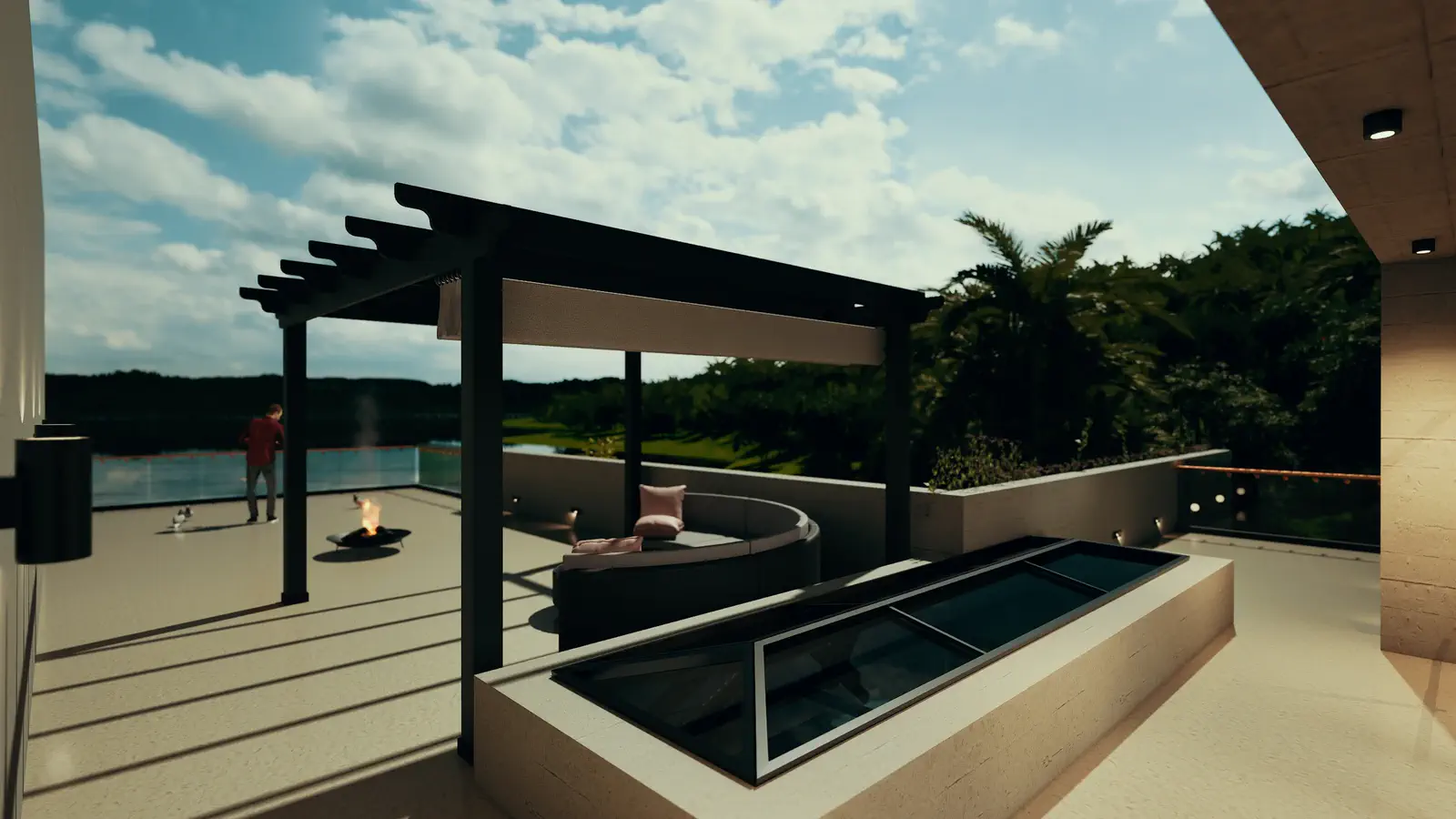
Level 5 terrace: timber pergola, low circular sofa around a fire bowl, skylight cut into the deck, Kaptai Lake horizon to the south Rooftop Terrace · Level 5
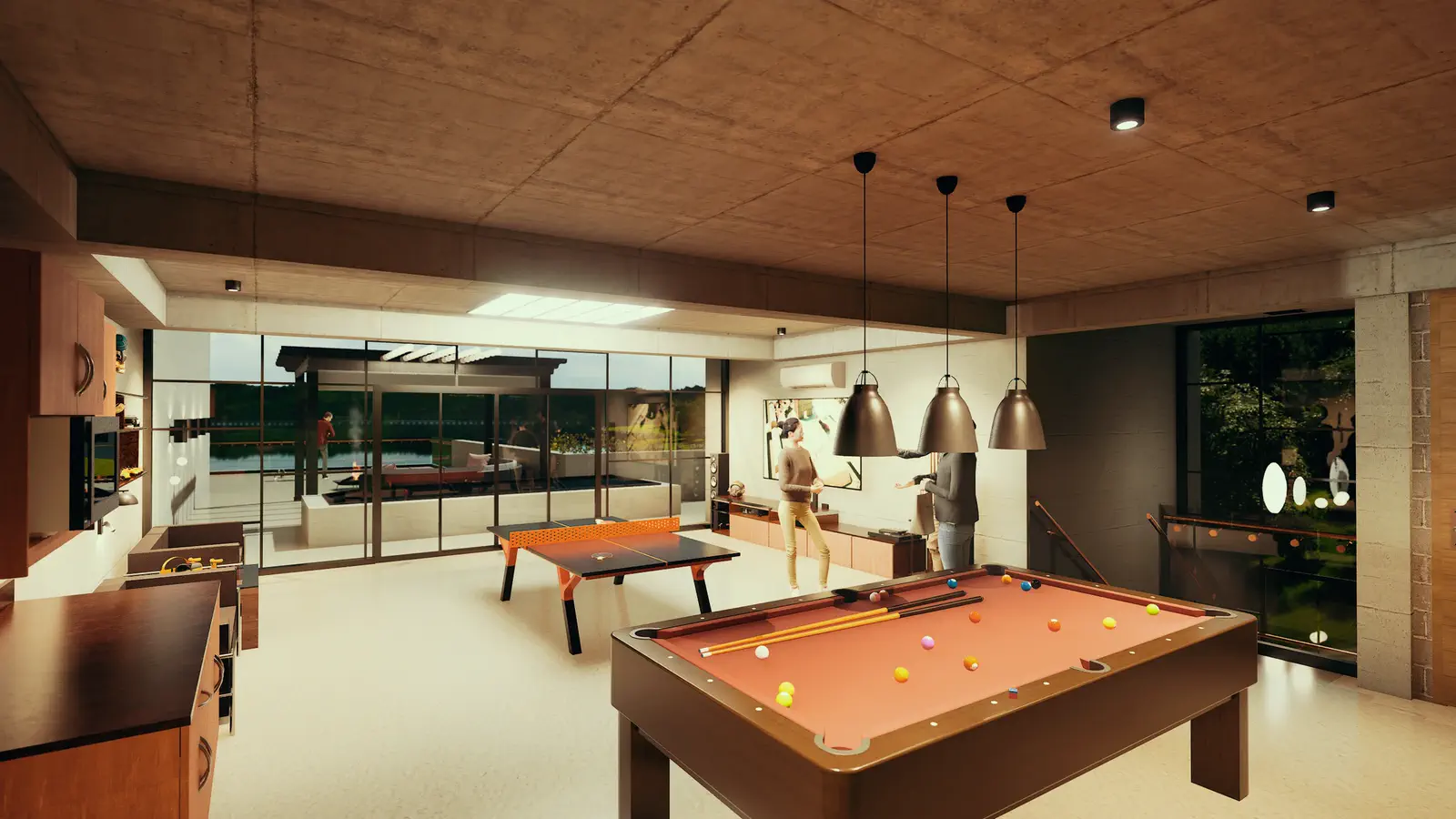
Entertainment zone at Level 5: covered outdoor living at the roof, seating, south-facing view across the Kaptai Lake Entertainment Zone · Level 5
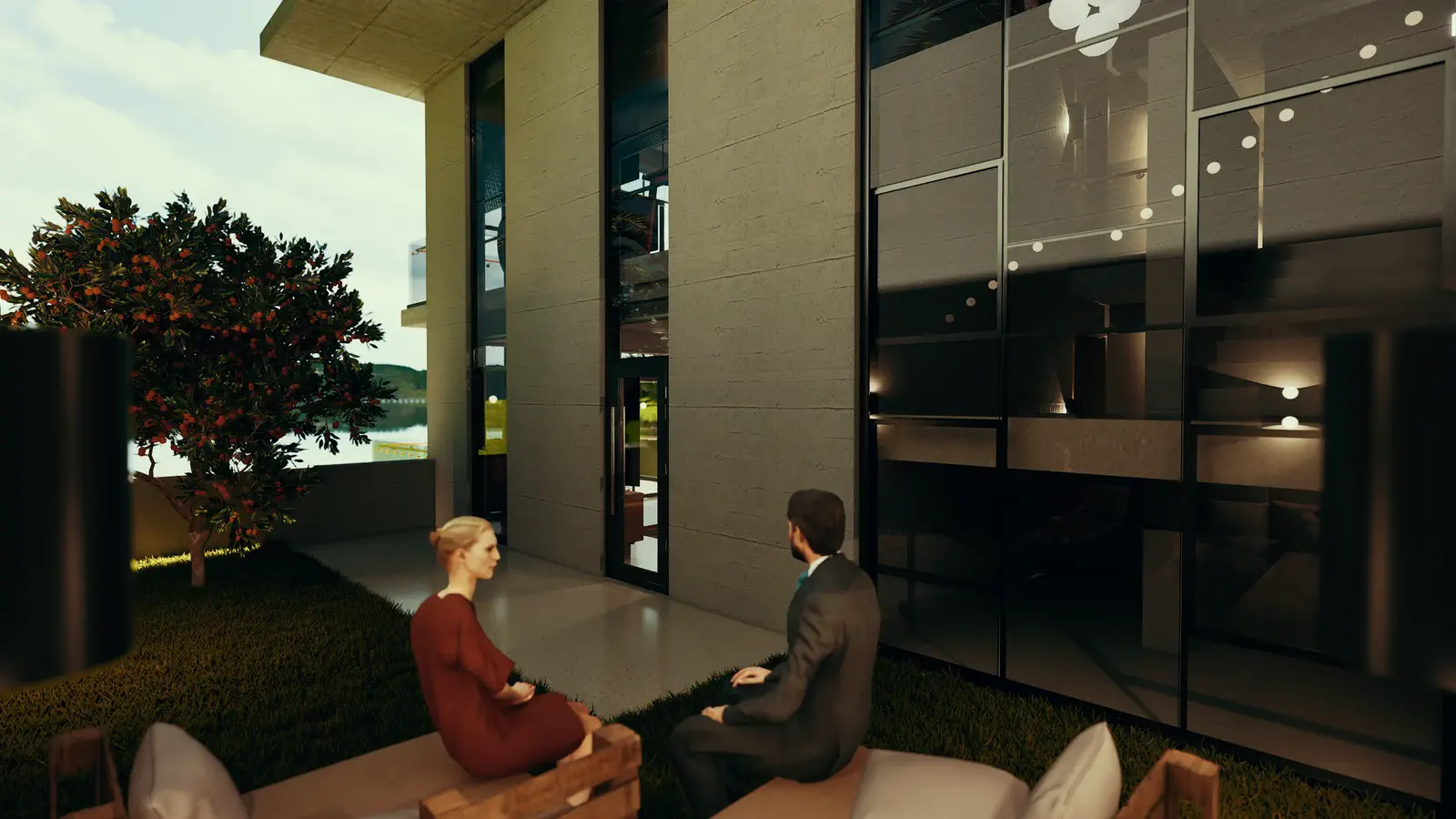
Grandparents' bedroom terrace: private outdoor terrace off the second master suite at Level 2, south-facing toward the Kaptai Lake Grandparents' Terrace · Level 2
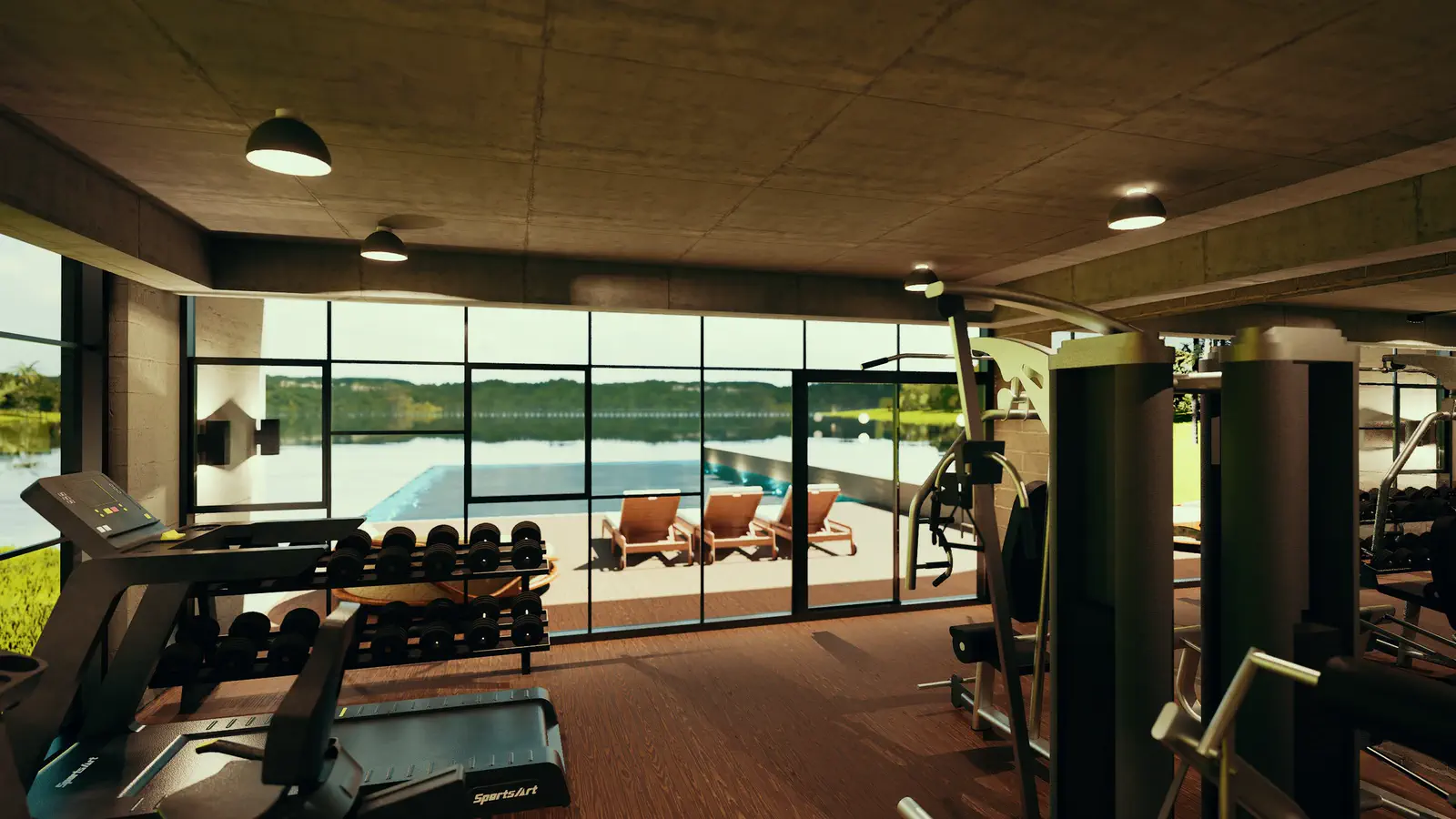
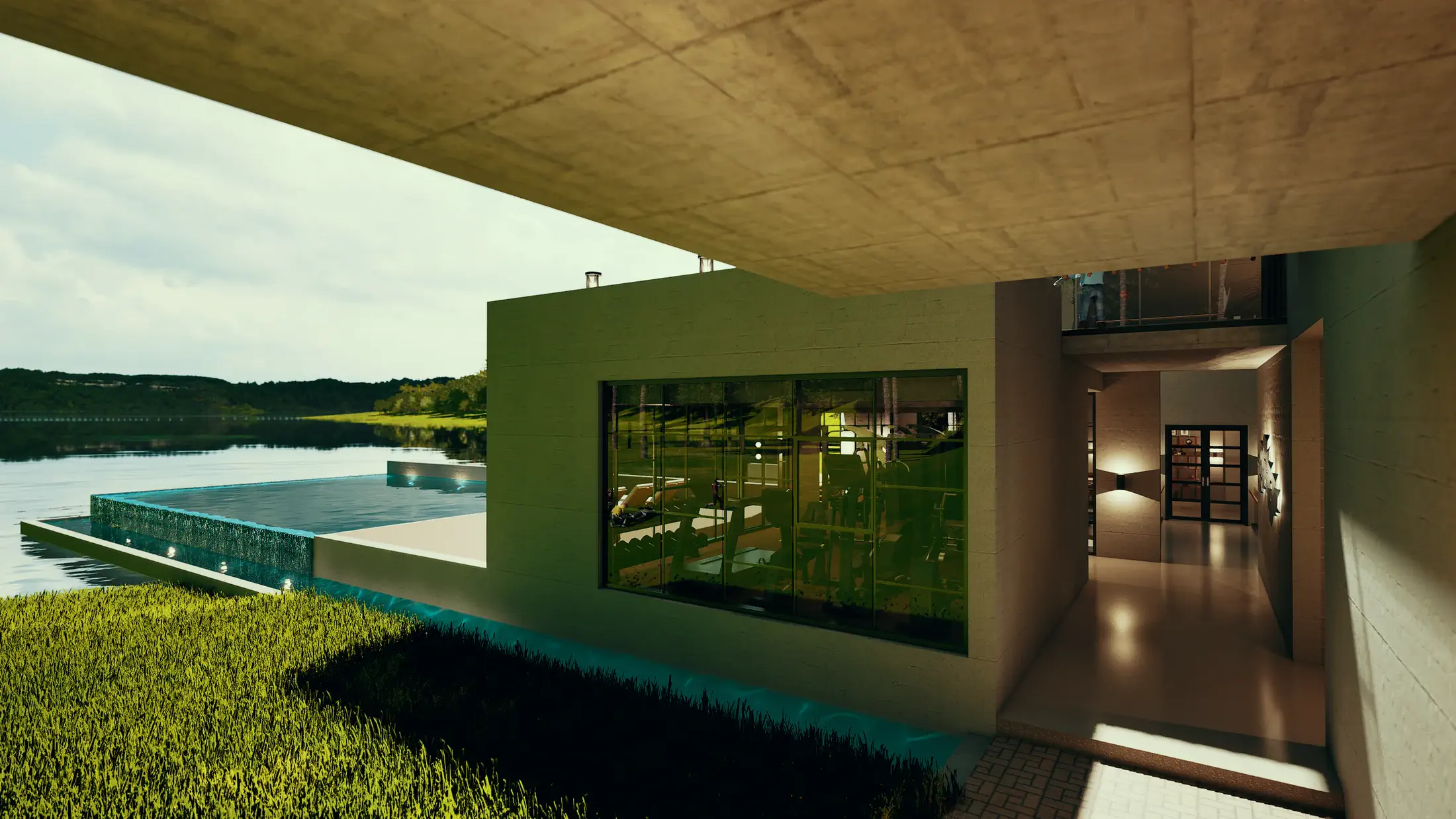
View from inside the gym at Level 1: looking south through glazing onto the infinity pool and beyond it the Kaptai Lake Gym · Level 1
Exterior view of the gym and infinity pool at Level 1: pool deck at water level, the lake surface continuous with the pool edge to the south Gym + Infinity Pool · Level 1

The Walk-Through

A short film made in Twinmotion, rehearsing the home as a sequence rather than a composition: arrival from the road, descent through the volumes, the long pause at the lake.

Theoretical Framework

Saif-ul-Haq
Architecture Within the Folk Tradition: A Representation from Bangladesh, TDSR Vol. V No. II, 1994 — The folk tradition is the direct translation into physical form of a culture, its needs and values: the world view writ small. In the Bangladeshi bari, all rooms orient toward a central courtyard (uthan). The old proverb — South facing is king of rooms — encodes a cardinal logic that governed every placement, every window, every threshold. Life and architecture are completely united.
Gottfried Semper
The Four Elements of Architecture, 1851 (via Saif-ul-Haq, 1994) — Semper began not from form but from the hearth: fire as social nucleus, gathering point for the family, the germ of civilisation. Architecture stems logically from this non-spatial, social-significance-bestowing act. The studio brief — design a home for an architect — returned this project to the same origin point.
James A. Tuedio
Thinking About Home: An Opening for Discovery in Philosophical Practice, 2002 — In the classic instance we aim to translate our sense of home from heart to hearth. Home materialises identity through the endowing of things with living meaning: the arrangement and preservation of things as an intrinsically valuable, irreplaceable aspect of homemaking. The title of this project — substituting hearth for heart in Eliade's phrase — performs exactly this translation.
Amos Rapoport
House Form and Culture, 1969; Defining Vernacular Design, 1990 (via A.K.M. Kausarul Islam, 2003) — The folk tradition is much more closely related to the culture of the majority and life as it is really lived. Rapoport's polythetic approach assesses built environments not by single attributes but by clusters of process and product characteristics. The Bengali house scores high on both: climatically deliberate, courtyard-centred, culturally specific, and open-ended across generations.
Qazi Azizul Mowla
Spatial Manifestation of Societal Norms, Khulna University Studies, 1999 (via A.K.M. Kausarul Islam, 2003) — The nuclei of rural Bengali social structure are the household (ghar) and homestead (bari). The Bengali house is a grouping of isolated rectangular rooms around a court (uthan): formal zone on the outer edge for the male domain, informal zone at the centre for the female. All rooms face the court. The uthan is not just a spatial device — it is the basic module of social organisation. The section of this project is the bari redrawn on a Rangamati hillside.
D.M. Hasan
A Study of Traditional House Forms in Bangladesh, BUET M.Arch, 1985 (via A.K.M. Kausarul Islam, 2003) — Classification of rural house typologies across the regions of Bangladesh; the plinth, the verandah, and the inner court as the primary spatial categories of Bengali dwelling. In the hilly areas of Chittagong, homesteads are built sparsely on sloping areas, following the contour lines of the hills. This project inherits that hillside logic.
Peter Zumthor
Thinking Architecture, 1998 (via Architecture, Memory and Fantasy: Reflections on Architectural Philosophy): "Memories like these contain the deepest architectural experience that I know. They are the reservoirs of the architectural atmospheres and images that I explore in my work as an architect." Zumthor's childhood sensory archive: a brass door handle shaped like the back of a spoon, a kitchen that was simply a kitchen. These images name the condition this project aspires to: architecture so fused with life that it ceases to be noticed, where one stops living the architectural to live the place. Heidegger, drawn into the same essay: we do not dwell because we have built, but we build and have built because we are dwellers. The home is not a programme; it is a consequence of dwelling.
Metamorphosis Bissaw Shahitto Kendro