About Contact
VoidCraft

Speculative Practice · RMIT APP3 · Semester 2, 2025

VoidCraft

Digital Twin Consultancy Melbourne Urban Simulation VR / AR NVIDIA Omniverse

VoidCraft is a Melbourne-based architectural consultancy dedicated to transforming how cities are planned, designed, and evaluated through next-generation digital twin technology. The service bridges the gap between traditional architectural design and data-driven urban simulation by offering an immersive, interactive, and analytical platform that enables clients to test design ideas, visualise urban impacts, and engage stakeholders before a single brick is laid.

The proposition is a simultaneous macro and micro digital twin: a city-scale model of Greater Melbourne combined with project-specific modelling for individual developments. The twin can run traffic flow, wind, sun and shadow, flood resilience, pedestrian movement, and zoning impact scenarios in real time. Neither purely a city simulation nor a single-purpose engineering study: both at once.

A hypothetical practice developed as part of RMIT's Architecture Professional Practice 3 course. Three M.Arch graduates propose a partnership registered in Victoria, built on a technology stack of NVIDIA Omniverse, ArcGIS CityEngine, SimScale, Unreal Engine, Rhino, Revit, and Bentley iTwin.

Course Architecture Professional Practice 3
Ton Vu
Institution RMIT University
Melbourne, Victoria, Australia
Partners Shahriyar Ahmad (Principal Consultant)
Gharaza Kaleem (Urban Strategy)
Nicole Markis (Project Development)
Structure Partnership (hypothetical)
Victoria · May 2025
Tech Stack NVIDIA Omniverse · ArcGIS CityEngine · SimScale · Unreal Engine · Rhino · Revit · Bentley iTwin
Year 2025

Service Output: Digital Twin

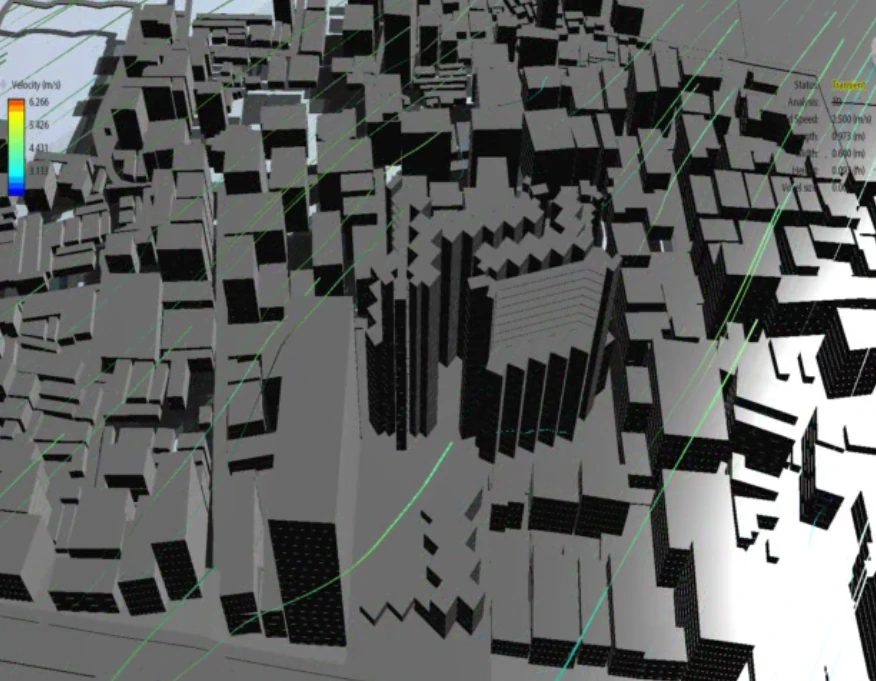
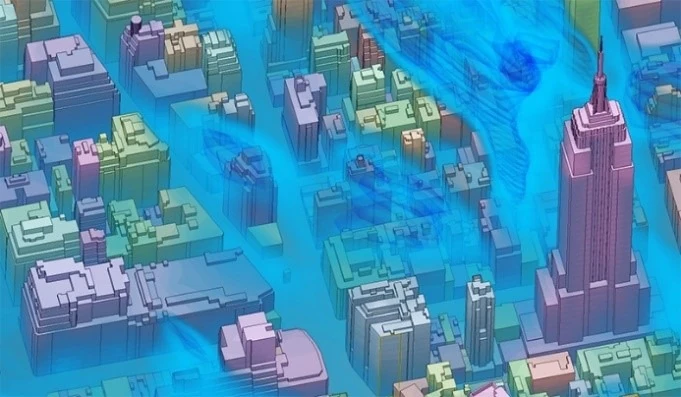
Melbourne CBD wind simulation: computational fluid dynamics over urban massing

Wind Simulation: Melbourne CBD

City-scale wind simulation reference: computational fluid dynamics over urban massing

Real-Time Design Feedback for Architects
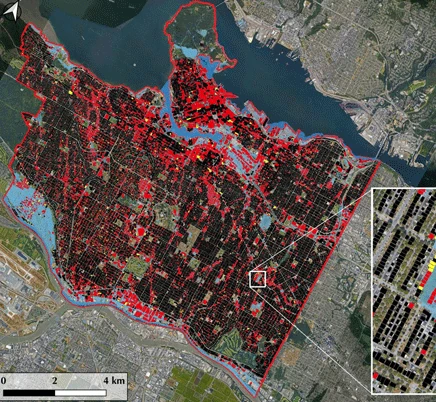
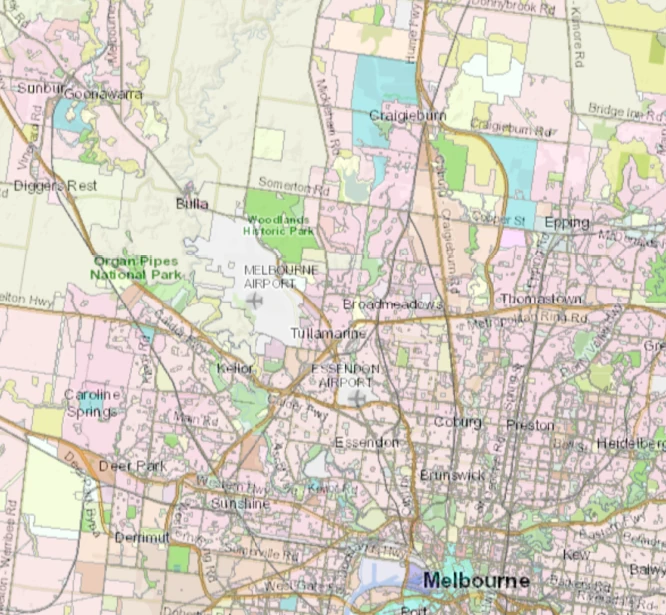
Climate and flood risk simulation

Climate + Flood Risk Simulation

Urban zoning and planning scenarios

Urban Zoning + Planning Scenarios

Full City Digital Twin Baseline A living, cloud-hosted model of Melbourne. VoidCraft begins with a city-scale 3D mesh and layers real-time data on top.
Integrated Workflow Suite Fuses 3D models, live simulations, and dashboards into one coherent environment for design, analysis, and stakeholder review.
Stakeholder-Centred Design Interfaces enable real-time exploration by clients, policymakers, and citizens through VR walkthroughs and interactive dashboards.

Operations

BIM-to-Digital Twin Conversion $50,000/project: transforming CAD/BIM models into interactive, geolocated digital twin environments in real-time Melbourne context
Environmental + Urban Simulation $30,000/project: wind, thermal comfort, solar access, pedestrian and traffic flows, flood and climate resilience
VR/AR Stakeholder Interface $40,000/project: interactive 3D dashboards and VR walkthroughs for councils and community feedback
Advisory Reports + Metrics $30,000/project: KPI visualisation for design performance, sustainability metrics, and impact modelling

Production

Software suite includes Revit, Rhino, ArcGIS CityEngine, SimScale, NVIDIA Omniverse, and Unreal Engine. Data is sourced from clients, open datasets, and city agencies. Workstations, cloud rendering, and VR rigs support in-house processing.

Digital Technology

Omniverse + CityEngine + SimScale Core simulation and collaboration platform
VR/AR Dashboards Immersive client interfaces
Xero + HubSpot CRM Accounting and client management
AWS/Azure Cloud + Git LFS Encrypted storage, versioned models, weekly backups

Design Services + Workflow

1. Client Consultation + Goal Setting Understand the project's scope, objectives, and challenges. Produce a clear project brief outlining analyses, data required, timeline, and data-sharing agreements.
2. Data Gathering + Digital Twin Setup Preparation of the digital twin environment. A project-specific digital twin instance, augmented to the client's needs.
3. Simulation + Analysis Computational fluid dynamics, sun/shadow analysis, flood inundation model, and/or traffic microsimulations. Host review sessions with the client.
4. Interactive Engagement + Review Finalise the interactive 3D model and simulations for VR setup or viewer, geolocated to the site so AR may be used onsite. Organise stakeholder workshops.
5. Reporting + Recommendations Comprehensive report detailing methodologies, assumptions, and findings from the digital twin model. Interpret data into actionable insights.
6. Follow-up + Integration Debrief meeting to walk through results and ensure all questions are answered. Run additional scenarios in accordance with project revisions if early-stage.

Assets

Premises Rented office space in Melbourne CBD
Workstations (3x) $36,000
VR/AR Headsets $7,500
Office Fit-out + Equipment $20,000

Cost + Time Efficiency

Software Licenses In-house: ~$15-20K/yr in subscriptions. VoidCraft: all included in service fee. Savings: ~$15-20K/yr.
Hardware / Infrastructure In-house: $20-50K one-time capital. VoidCraft: hosted on cloud platform. Savings: ~$20-50K.
Personnel In-house: 3-5 specialists (~$200-300K/yr in salaries). VoidCraft: no new full-time hires, project-based support only.
Training / Ramp-Up In-house: 6-12 months to recruit and train. VoidCraft: immediate, expert team ready on Day 1.
Project Turnaround In-house: ~12+ months for a full digital twin. VoidCraft: ~6-8 months. Roughly 50% faster completion.
Implementation Risk In-house: higher (steep learning curve, integration errors). VoidCraft: lower (proven processes and QA). Fewer errors, less rework.
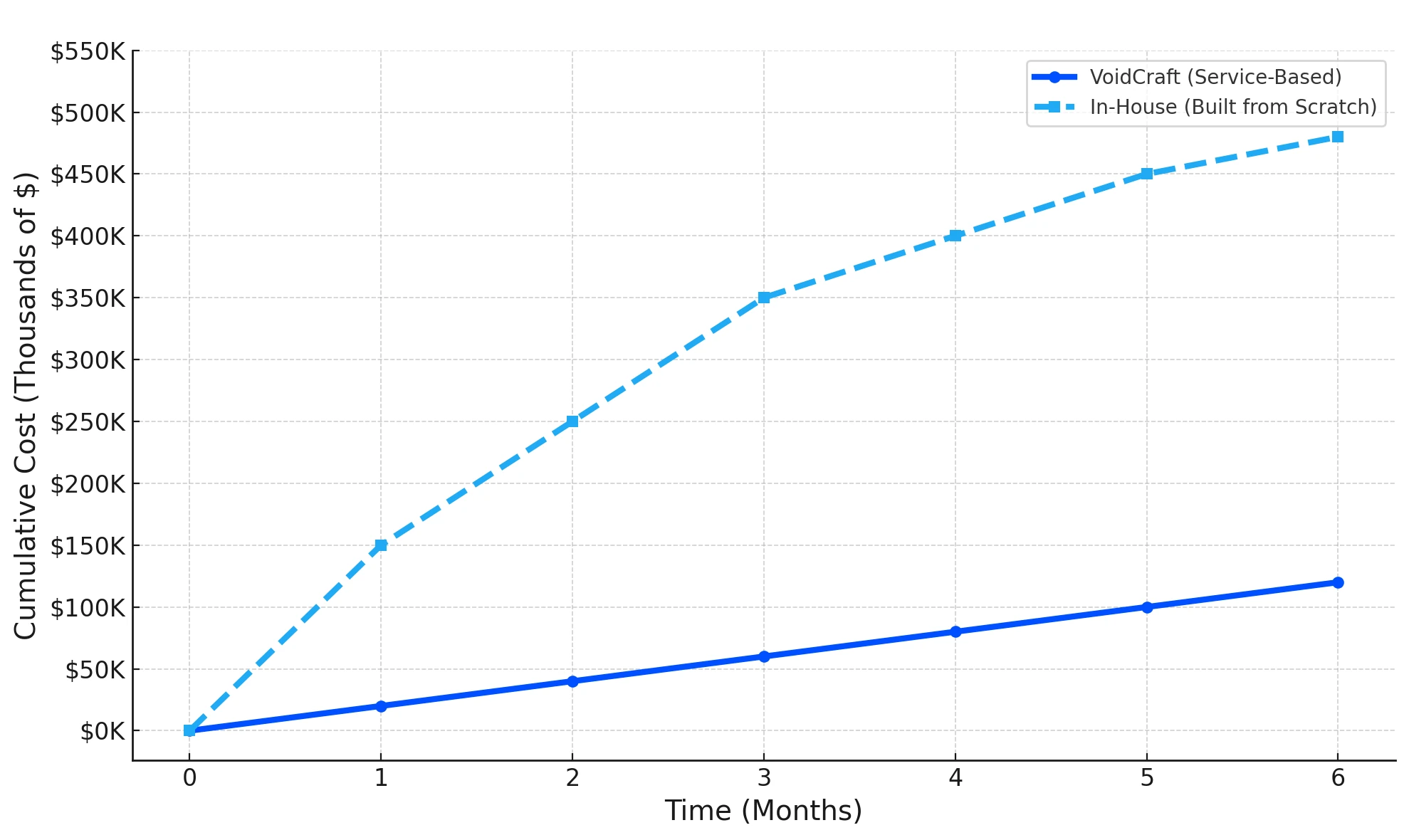
Cumulative cost comparison: VoidCraft service-based model versus in-house digital twin built from scratch over 6 months

VoidCraft vs In-House: cumulative cost over 6 months. Service-based model saves $200K+ in salaries, licenses, and infrastructure.

Competitor Identification

Arup Engineering pedigree. Low-road + stakeholder engagement. Detached from policy. Not local.
DBA Analytics Parametric, specialist. Design-led, immersive focus. We integrate data + planning natively.
CityMade / USNoise Small-scale EU markets. We're Melbourne-native, embedded in local context.

Market Research

The market for digital twins in architecture and urban planning is rapidly growing. Governments worldwide are funding smart city platforms (e.g. Singapore's Virtual Singapore, Australia's $37.4M Digital Twin Victoria), signalling strong demand. Industry publications note that regulators are beginning to expect digital twin strategies in major projects. Despite this momentum, uptake in traditional practice remains limited, leaving a gap for VoidCraft.

The Problem Urban planning tools are fragmented, static, and disconnected from lived experience. Stakeholder engagement remains abstract and non-immersive.
Our Solution VoidCraft integrates BIM, GIS, and real-time simulation in a single immersive platform, allowing all stakeholders to see, feel, and test the future of the built environment.
Target Market Architects, councils, developers, planning consultants, and research institutions in Greater Melbourne. Focused on mid-to-large scale public and mixed-use developments.
Unique Service Offering VoidCraft operates at the intersection of architecture and technology: a consulting agency with a city-scale digital twin, offering simulation-as-a-service with stakeholder-ready outputs.

SWOT Analysis

Strengths Specialised niche with minimal local competition. Strong academic and industry backing through RMIT. Integrated BIM + GIS + simulation + VR/AR workflow. Fully built digital twin of Greater Melbourne.
Weaknesses Newly established firm with limited built portfolio. High dependency on the founding team. Lower brand visibility compared to legacy firms.
Opportunities Increasing investment in smart cities, climate resilience, and urban analytics. Strategic partnerships with universities, councils, and civic institutions. Expansion potential into Sydney, Brisbane.
Threats Fast-changing technology landscape requiring constant upskilling. Large engineering firms (e.g. Arup, AECOM) may enter with scale advantage. Stringent data governance and rising compliance costs.

Key People

Shahriyar Ahmad Shahriyar Ahmad Co-founder / Principal Consultant. M.Arch RMIT. Digital twin expertise, ex-ADS + Indigenous Architects.

Nicole Markis Nicole Markis Co-founder (Project Development + Stakeholder Management). M.Arch RMIT, A.Dip Building Design (RMIT).

Gharaza Kaleem Gharaza Kaleem Co-founder (Urban Strategy + Visual Communications). M.Arch RMIT.

Sources of Advice + Support

Business Mentoring RMIT Entrepreneurship Hub
Strategic Reviews Former tutors from MGS Architects and other firms
Accounting Xero and Advisor Network

Goals + Actions

Goals for Next Year

Deliver 3 Paid Pilot Projects Gharaza Kaleem · by 31/12/2025. Identify and pitch to 5 target clients; secure contracts and deliver case studies.
Secure Recurring Council Client Nicole Markis · by 30/11/2025. Present demo to 3 councils; align proposal with DTV goals and urban renewal frameworks.
Launch VR Platform v1 Shahriyar Ahmad · by 31/10/2025. Complete beta testing; implement feedback from pilot clients; soft launch online.

Goals for Next 3 Years

Scale to 9 Projects/Year Gharaza Kaleem · by 31/12/2028. Expand business development; hire 1 project manager; grow referral network.
Employ 3 Full-time Staff Nicole Markis · by 30/06/2027. Convert 2 contract staff to permanent roles; define recruitment plan.
Expand Twin Coverage to Sydney Shahriyar Ahmad · by 31/12/2028. Partner with Sydney-based university or planning agency; adapt twin infrastructure.

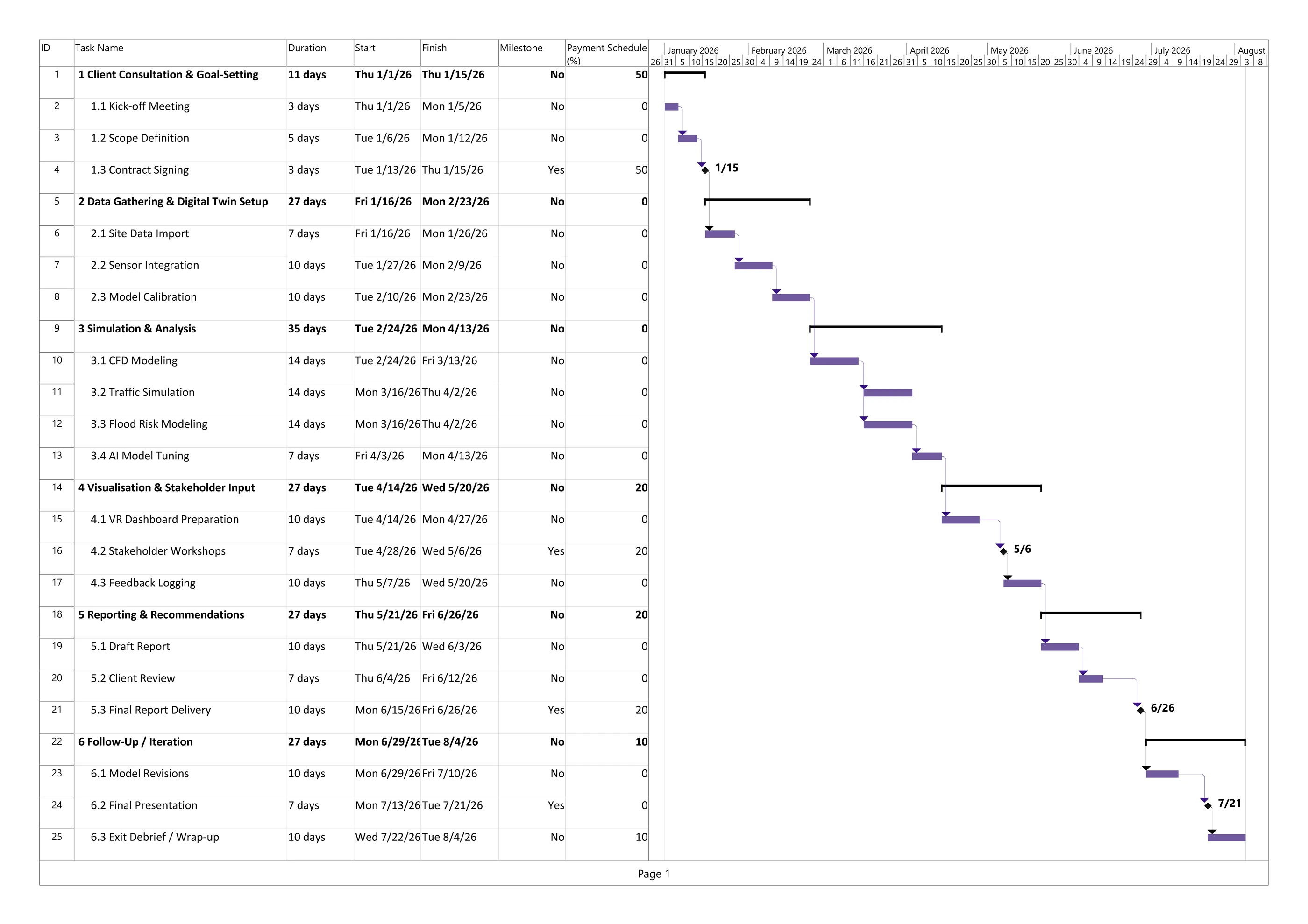
Typical Project Timeline

Detailed Gantt chart: single project timeline with task dependencies, milestones, and payment schedule

Single project Gantt chart with milestones and payment schedule

Business Plan Report

Tubythm Maer Bari